Command Palette
Search for a command to run...
Hunyuan3D-Part: Component-based 3D Generative Model
An error occurred in the Server Components render. The specific message is omitted in production builds to avoid leaking sensitive details. A digest property is included on this error instance which may provide additional details about the nature of the error.
Failed to load notebook details1. Tutorial Introduction


Hunyuan3D-Part, launched by Tencent's Hunyuan team in September 2025, is a 3D generative model composed of P3-SAM and X-Part. It is the first to achieve high-precision, controllable component-based 3D generation, supporting the automatic generation of 50+ components. Users can first generate the overall mesh using Hunyuan 3D 2.5 or 3.0, then P3-SAM performs automatic and precise component segmentation, and X-Part decomposes it into independent parts, outputting high-fidelity, structurally consistent part geometry while maintaining flexibility and controllability. It has wide applications in game modeling, 3D printing, and other fields, such as separating a car model into its body and wheels to facilitate game-based scrolling logic or step-by-step 3D printing. Related research papers are available. P3-SAM: Native 3D Part Segmentation and X-Part: high fidelity and structure coherent shape decomposition .
The computing resources used in this tutorial are a single RTX A6000 card.
2. Effect display
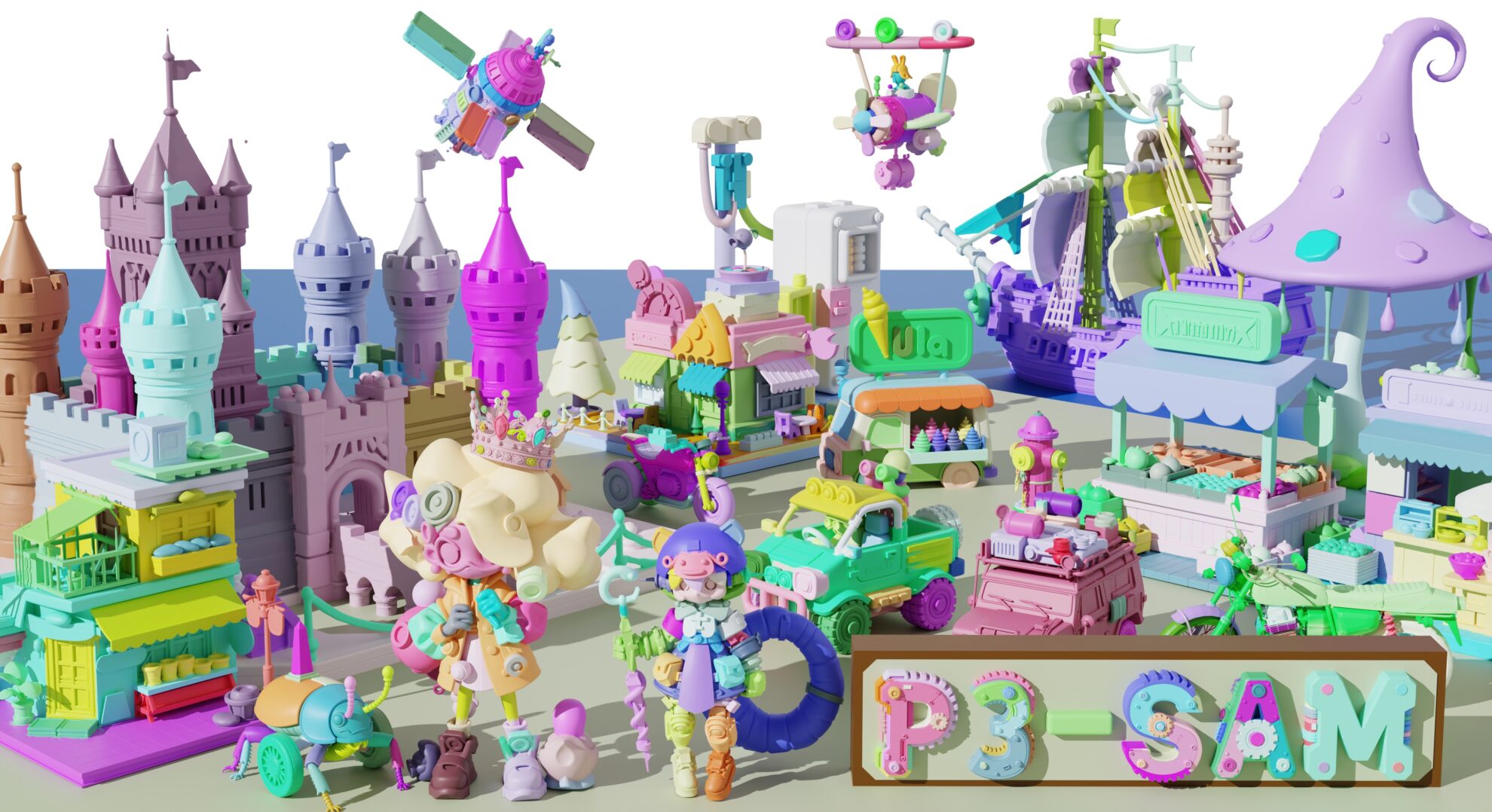
P3-SAM:Native 3D part Segmentation
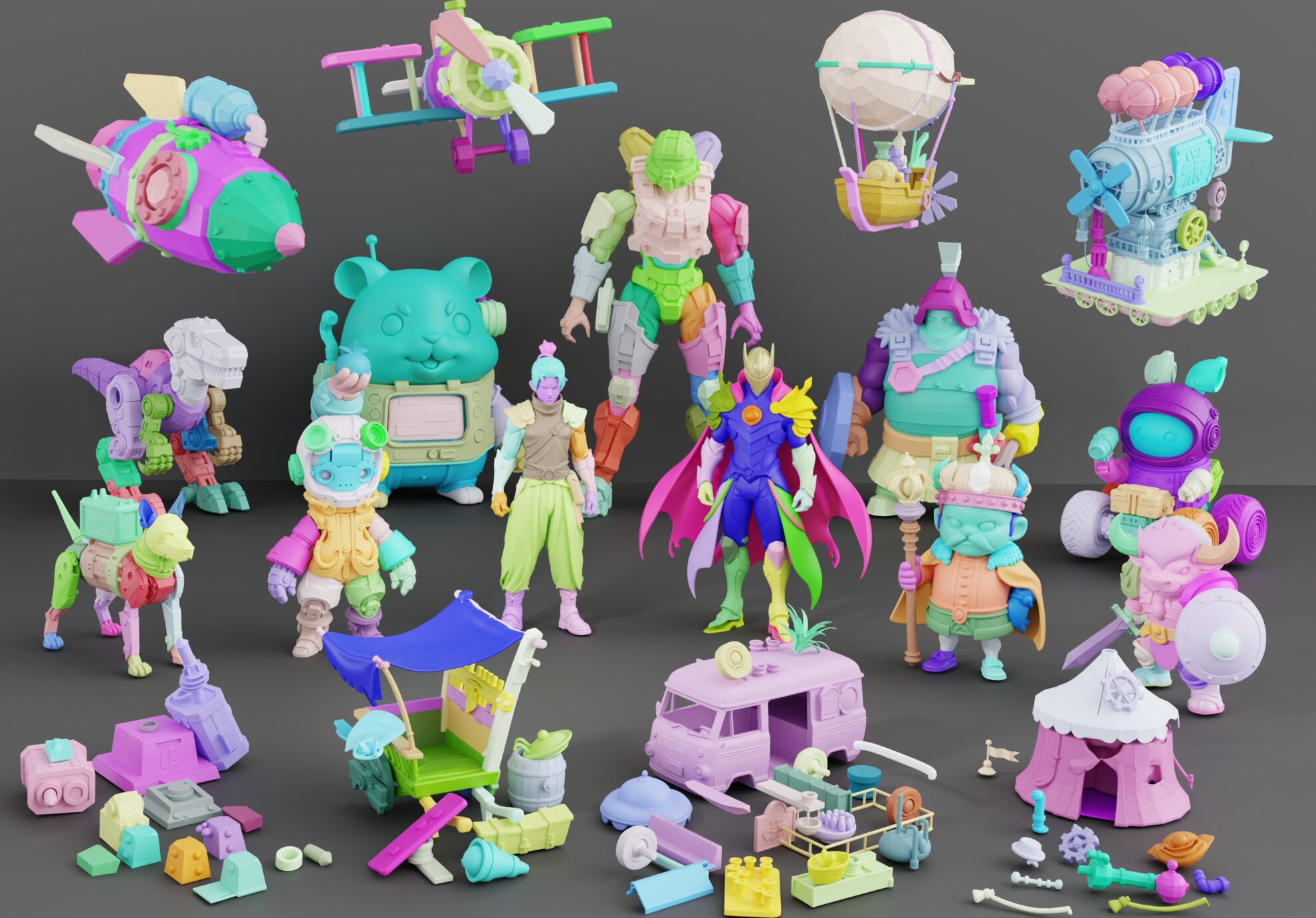
X-Part: high-fidelity and structure-coherent shape decomposition
3. Operation steps
1. Start the container

2. Usage steps
If "Bad Gateway" is displayed, it means the model is initializing. Since the model is large, please wait about 2-3 minutes and refresh the page.
Note: It takes about 1 minute for the browser to load and display the glb file. Please be patient.
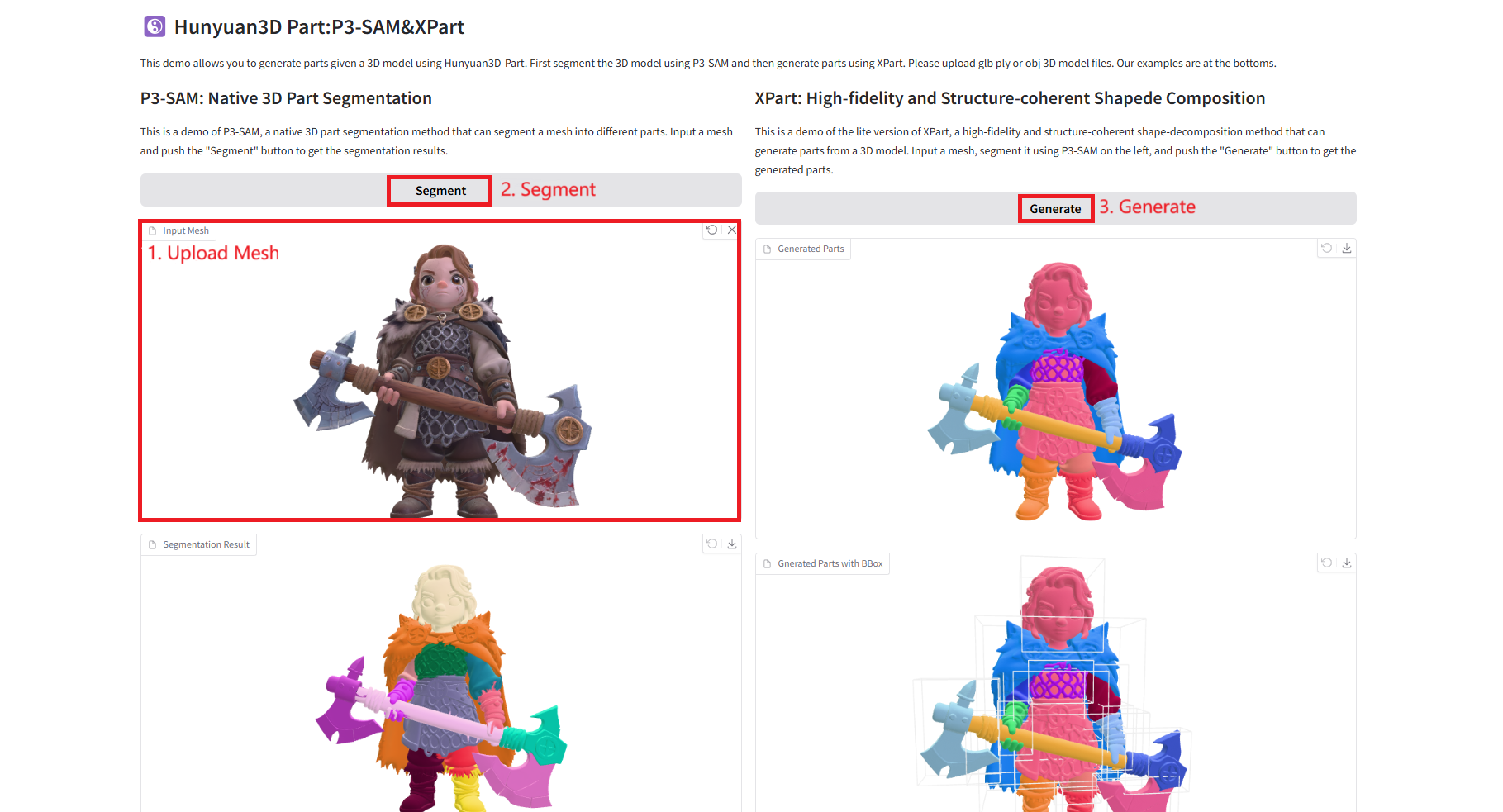
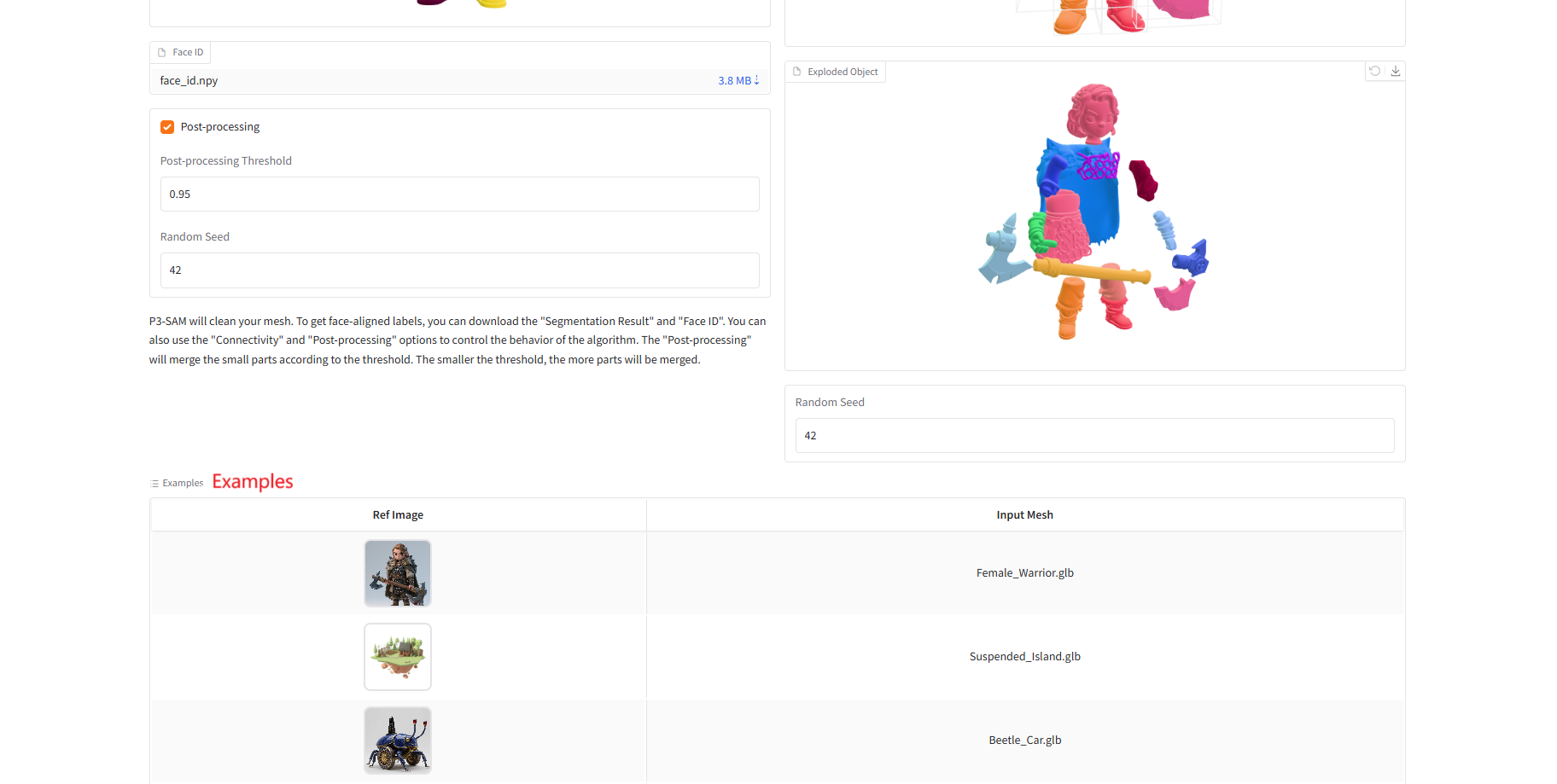
Specific parameters:
- Post-processing: Whether to enable the post-processing step within P3-SAM.
- Post-processing Threshold: Takes effect when post-processing is enabled. This threshold controls the strength of merging. A smaller value (e.g., 0.8) means a lower requirement for similarity between parts before merging, resulting in more small parts being merged into adjacent large parts and fewer parts being retained. A larger value (e.g., 0.99) requires very similar parts before merging, resulting in a higher number of retained parts.
- Random Seed: Controls the randomness involved in the P3-SAM segmentation process (such as sampling points, color assignment, etc.).
Citation Information
The citation information for this project is as follows:
@article{ma2025p3sam, title={P3-sam: Native 3d part segmentation}, author={Ma, Changfeng and Li, Yang and Yan, Xinhao and Xu, Jiachen and Yang, Yunhan and Wang, Chunshi and Zhao, Zibo and Guo, Yanwen and Chen, Zhuo and Guo, Chunchao}, journal={arXiv preprint arXiv:2509.06784}, year={2025} }@article{yan2025xpart,
title={X-Part: high fidelity and structure coherent shape decomposition},
author={Yan, Xinhao and Xu, Jiachen and Li, Yang and Ma, Changfeng and Yang, Yunhan and Wang, Chunshi and Zhao, Zibo and Lai, Zeqiang and Zhao, Yunfei and Chen, Zhuo and others},
journal={arXiv preprint arXiv:2509.08643},
year={2025}
}
Build AI with AI
From idea to launch — accelerate your AI development with free AI co-coding, out-of-the-box environment and best price of GPUs.