Command Palette
Search for a command to run...
From Drug-like Molecules to Target-specific Compounds: University of Pittsburgh Accelerates Targeted Drug Discovery With Molecular Fingerprint Search
Traditional drug discovery is a highly challenging task whose core goal is to identify molecules with specific desirable properties that can act on specific targets within a vast chemical space. From the initial research and development idea to final approval for market launch, developing a new drug costs more than USD 2.6 billion and takes more than 12 years. One fundamental challenge is how to efficiently search the vast chemical space containing 10^23–10^60 molecules to find compounds that simultaneously possess the desired biological activity, physicochemical properties, and synthetic accessibility.
In recent years, generative artificial intelligence has brought new possibilities to molecular design. By learning the structures and properties of existing molecules, generative models can explore potential chemical spaces and propose candidate molecules with specific physicochemical properties or biological activity characteristics. However, how to translate molecules generated by models into compounds with valid chemical structures, practical availability, and genuine biological activity remains an important challenge in this field.
Against this backdrop, a research team from the University of Pittsburgh in Pittsburgh, Pennsylvania, USA, proposed a Full-Spectrum Generative Lead Discovery (FSGLD) workflow, a deep learning-driven method for efficient drug lead identification. At the core of FSGLD is the multiscale DRUG-GAN model, which can guide drug molecule discovery through generative models in three different scenarios, including:
(1) generating random drug-like compounds;
(2) generating target-specific compounds;
(3) generating target-specific series of compounds with common chemical structures.
In evaluations against three types of targets with distinct pharmacological characteristics, FSGLD demonstrated promising potential for identifying target-specific candidate compounds. In addition, the study established a computational workflow for thermodynamic integration (TI) calculations, reducing computation time by 80% to 90% while maintaining computational accuracy.
The relevant research results were published in Science Advances under the title “A Full-Spectrum Generative Lead Discovery (FSGLD) pipeline via DRUG-GAN: A multiscale method for drug-like/target-specific compound library generation.”
Research highlights:
-
The FSGLD workflow can not only use generative models to design drug-like and target-specific compounds, but also systematically and efficiently screen and validate candidate compounds
-
The researchers built a practical and scalable framework that is expected to reduce the time and cost required for preclinical drug discovery
-
The compounds generated through this workflow are not merely theoretical candidate molecules, but are feasible for further experimental validation, bringing tangible value to academic researchers and pharmaceutical industry practitioners
Paper link:
https://www.science.org/doi/full/10.1126/sciadv.aei5257
Dataset: Different datasets for three application scenarios
FSGLD designs three application scenarios for different lead discovery tasks, and therefore uses different datasets and training strategies.
For Scenario I, researchers collected 7,002 drugs from the DrugBank database (https://go.drugbank.com/) by applying Lipinski’s Rule of Five and diversity filtering to construct a drug-like compound dataset.
For the decoy molecule set, researchers used Open Babel to calculate the molecular weight (MW) and lipophilicity partition coefficient (logP) of 19,212,639 molecules in the drug-like subset of the ZINC database. Subsequently, researchers used an internally developed program to select 284,552 ZINC compounds whose MW and logP values were most similar to those of DrugBank compounds. Next, using SYBYL-X 2.1.1 software, these compounds were clustered based on molecular fingerprints (FP) to maximize their structural diversity. Finally, researchers selected 9998 molecules to construct the decoy molecule set.
To train and validate the dcGAN discriminator, researchers adopted a ten-fold cross-validation method ([75]) and divided all selected drug-like molecules (7002) and decoy molecules (9998) into training and test sets.
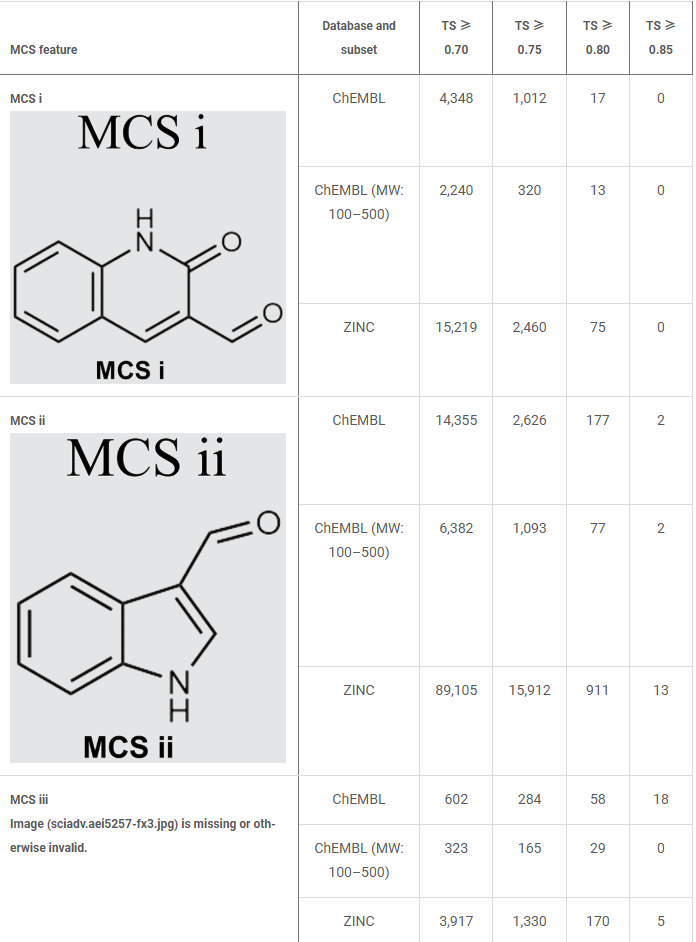
For the generation of target-biased compounds in Scenarios II and III, researchers collected 1,896 CB2-active compounds (Ki/IC50 below 100 nM) and 2996 CB2-inactive compounds (Ki/IC50 greater than or equal to 100 nM) from the ChEMBL database for training the cdcGAN model. In addition, researchers manually inspected the chemical structures of the collected CB2-active compounds and identified the three most common maximum common substructures (MCS) among them, as shown in the table below:
During model training, all molecules were converted into MACCS molecular fingerprints (168-bit) using Open Babel version 2.3.1. For further validation, researchers obtained the X-ray crystal structure of CB1 and constructed a homology model of CB2.
FSGLD Framework: Centered on DRUG-GAN
At the core of FSGLD is DRUG-GAN. Its key idea is not to directly generate complete molecular structures, but rather to learn the distribution of molecular fingerprints, generate fingerprints with specific properties, and then use them as query conditions to retrieve structurally similar real compounds from large chemical databases. An overview of the workflow is shown below:
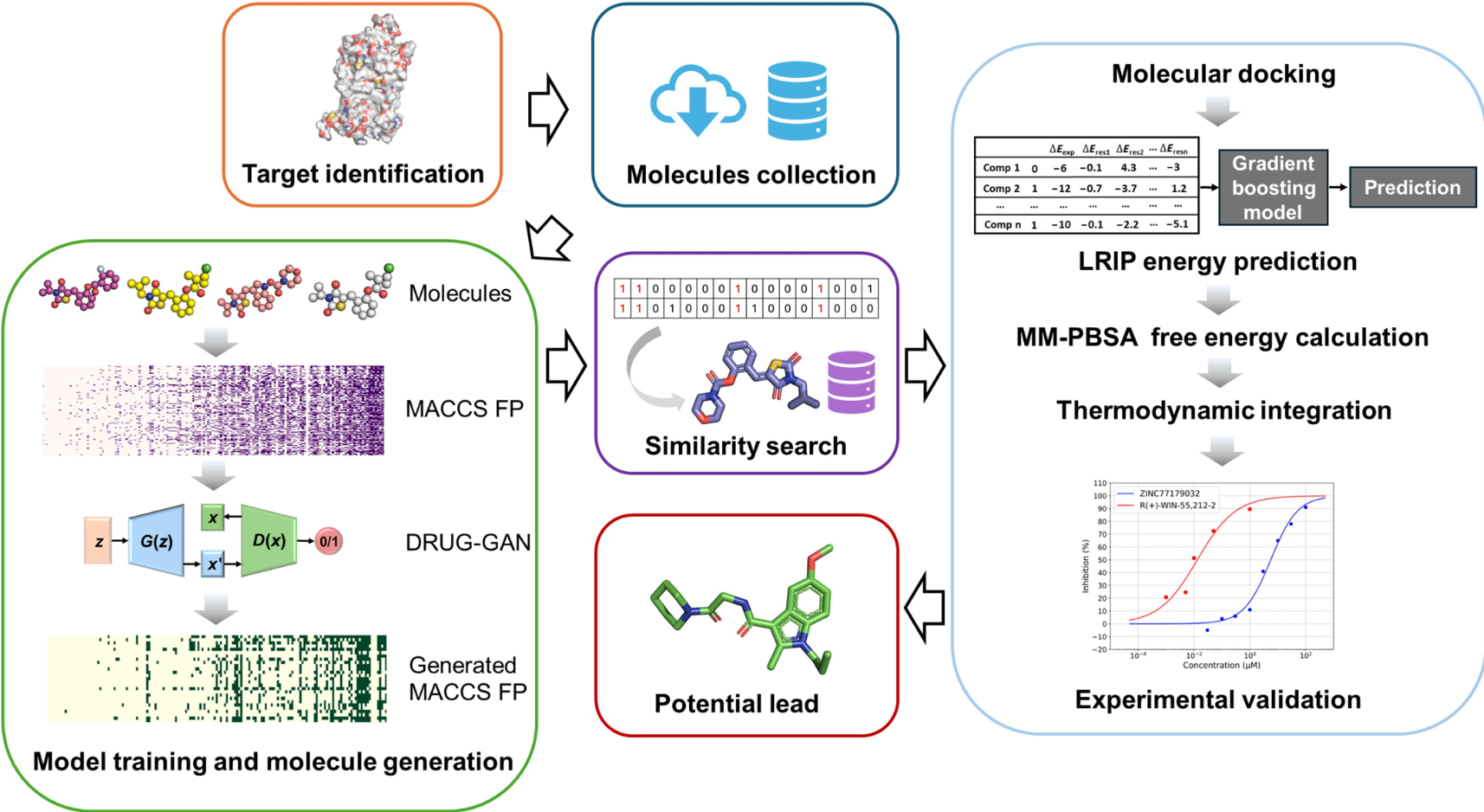
This design differs from traditional generative models based on SMILES strings or molecular graphs. MACCS molecular fingerprints can describe molecular structural features in a compact form and are well suited for learning from relatively limited datasets. However, because molecular fingerprints cannot be mapped uniquely to a single molecule and cannot be directly converted into chemically valid molecular structures, the fingerprints generated by DRUG-GAN must be further matched for similarity against databases such as ChEMBL and ZINC to obtain actual candidate compounds.
From the model architecture perspective, the researchers used a deep convolutional neural network (DCNN) to construct the discriminator and explored four major DCNN architectures: LeNet-5, AlexNet, ZFNet, and VGGNet.
Depending on different discovery objectives, DRUG-GAN was designed for three application scenarios.
Scenario I uses a standard dcGAN, with drug-like molecular fingerprints from DrugBank as real samples, to learn the characteristic distribution of drug-like molecules. The generator starts from random noise to generate new molecular fingerprints, and then uses similarity retrieval to find corresponding compounds from the ZINC database. This scenario is mainly used to explore chemical space with drug-like properties.
Scenario II further introduces target-specific information and uses a conditional generative adversarial network, cdcGAN. The model uses CB2-active and inactive ligands as two classes of training data to learn molecular fingerprint features associated with CB2 activity, thereby generating fingerprints with CB2-target bias. Subsequently, the researchers used the generated fingerprints as query conditions to retrieve candidate compounds from the ChEMBL and ZINC databases, extending the workflow from unbiased drug-like molecular exploration to target-oriented discovery.
Scenario III further improves the controllability of molecular design. The researchers introduced a mask layer into the generator, specifically using a Lambda layer to fix the molecular fingerprint feature bits corresponding to a predefined MCS, so that the generated fingerprints retain specified structural features while allowing other feature bits to vary. In this way, the model can generate compound series that combine CB2-target bias with specific scaffold features, supporting hit expansion and subsequent lead optimization.
After candidate compounds are generated, FSGLD also establishes a hierarchical computational screening workflow. First, molecular docking is used to evaluate the binding of candidate molecules to the target receptor, followed by screening using a target-specific LRIP scoring function. Then, molecular dynamics (MD) simulations, MM-PBSA binding free energy calculations, and thermodynamic integration (TI) calculations are performed. Only compounds that pass the current screening stage proceed to the next step. Finally, the researchers conduct experimental validation for higher-priority candidate molecules, forming a complete workflow from generation, retrieval, and computational screening to experimental evaluation.
Results: Good Performance Across Three Pharmacologically Distinct Target Assessments
The experimenters evaluated model performance across three scenarios:
Scenario I: Generation of Drug-Like Compounds
The researchers comprehensively compared DRUG-GAN with three previously published generative models—ORGAN, OR(W)GAN, and ORGANIC—across five dimensions: Uniqueness, Novelty, Diversity, Similarity, and Validity.
As shown in the table below, in the MACCS FP space, DRUG-GAN outperforms the other generative models used as benchmarks on several key metrics. In particular, DRUG-GAN achieves perfect scores of 1.00 for both uniqueness and novelty. This means that all generated molecular fingerprints are different from one another and none appear in the training data. Its diversity score is 0.73, close to the performance of ORGAN (0.77) and ORGANIC (0.76), and higher than that of OR(W)GAN (0.63). In addition, the average similarity between the molecular fingerprints generated by DRUG-GAN and 7002 reference drugs is the lowest, at only 0.25. This indicates that the model can generate molecular fingerprints with pronounced structural differences while retaining drug-like properties.
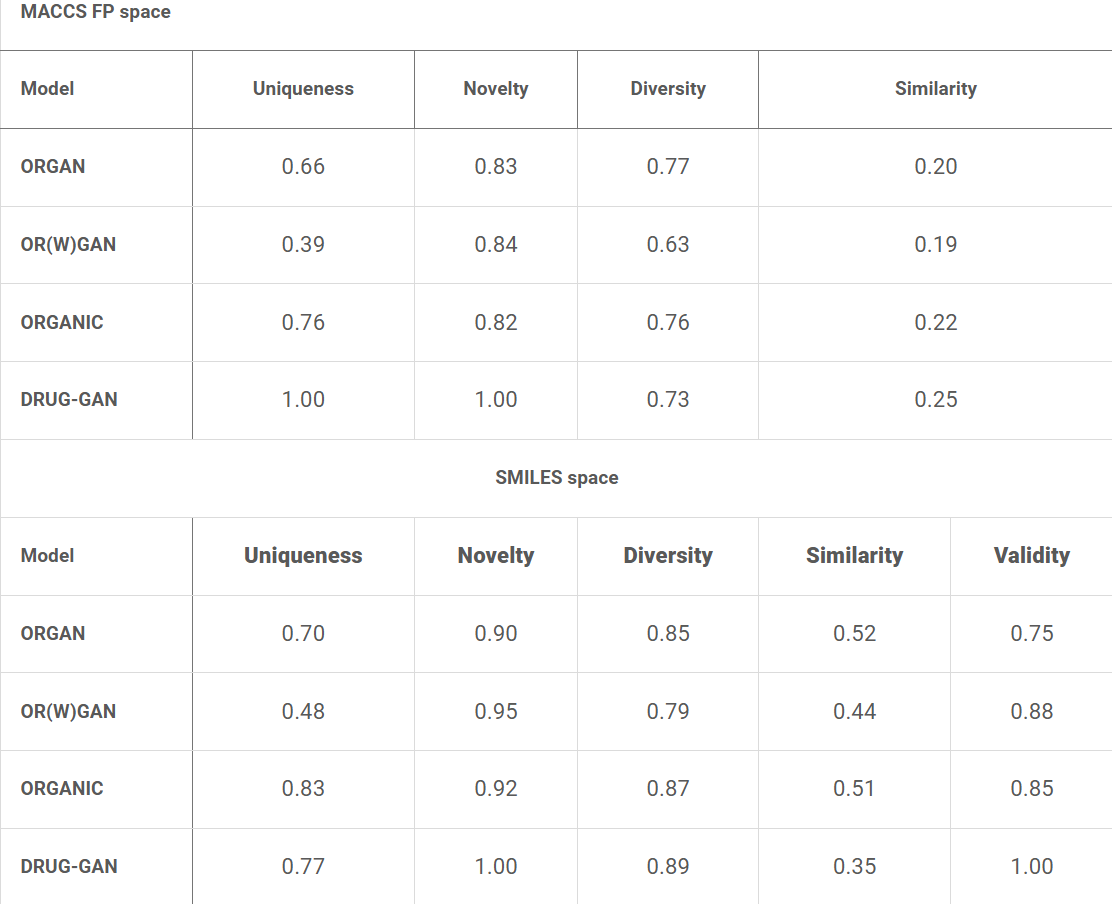
Consistent with the evaluation results in the FP space, DRUG-GAN also performs well in the SMILES space. The novelty score of DRUG-GAN remains at 1.00, indicating that all decoded molecules are absent from the training dataset. As expected, because multiple different molecular fingerprints may decode to the same molecular structure, its uniqueness score decreases from 1.00 in the FP space to 0.77 in the SMILES space. Nevertheless, the uniqueness of DRUG-GAN remains higher than that of ORGAN and OR(W)GAN, and is only slightly lower than that of ORGANIC. At the same time, DRUG-GAN also maintains high diversity, with a score of 0.89, while the similarity between its generated molecules and reference drugs is relatively low, with a score of 0.35. This is consistent with the model's design objective of expanding chemical space without sacrificing chemical validity.
To further evaluate these results, the researchers also analyzed 2252 drugs approved by the U.S. Food and Drug Administration (FDA), with molecular weight (MW) ranging from 100 to 1000 Da. The average MW, logarithm of the octanol/water partition coefficient (logP), and topological polar surface area (TPSA) of these approved drugs were 358.0 Da, 2.8, and 89.3 Ų, respectively. The molecules retrieved by DRUG-GAN exhibited similar drug-like properties, with an average MW of 382.9 Da, an average logP of 2.0, and an average TPSA of 76.0 Ų. These data indicate that compared with FDA-approved drugs, the molecules retrieved by DRUG-GAN are overall slightly larger in molecular weight but relatively lower in polarity, suggesting potentially favorable physicochemical properties.
Scenario II: Target-specific compound generation
In addition to generating drug-like candidate compounds, DRUG-GAN is also capable of generating target-specific compounds. To demonstrate this capability, the researchers conducted a study using cannabinoid receptor 2 (CB2) as an example.
Among the 186 ChEMBL compounds with a similarity of 85% or higher (TS ≥ 0.85) to the generated molecular fingerprints, 169 compounds had molecular weights (MW) between 100 and 500 Da, of which 104 compounds had been reported in bioactivity experiments as ligands with CB2 activity, with inhibition constants (Ki) less than 10 μM. The enrichment of low-Ki molecules among the retrieved compounds indicates that molecular fingerprint queries generated by DRUG-GAN can effectively retrieve known chemical structure types with CB2 activity from bioactivity databases associated with the target. In addition, the researchers retrieved 161 compounds from the ZINC database, all of which had a TS of 0.85 or higher with the molecular fingerprint queries generated by DRUG-GAN.
Subsequently, the researchers performed molecular docking of the retrieved compounds with the CB1 and CB2 receptors, respectively, to predict their binding affinities, with the results shown in the figure below:
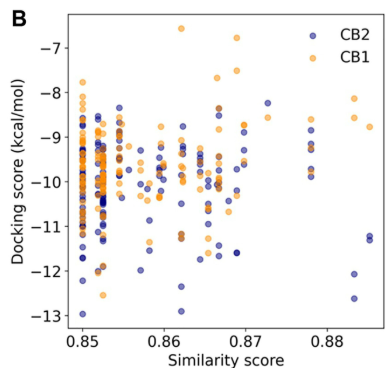
Overall, the compounds retrieved using the molecular fingerprint queries generated by DRUG-GAN showed better predicted binding to CB2, with an average molecular docking score against the CB2 receptor of −10.10 kcal/mol, which was better than the average value of −8.29 kcal/mol for the decoy molecules used for discriminator training in Scenario I. After paired comparison of the docking scores for each retrieved compound, the researchers further found that these compounds generally exhibited a binding preference for CB2, with a substantial proportion having predicted binding to CB2 better than to CB1.
Scenario III: Target-Specific Series Compound Generation
In Scenario III, the researchers introduced three predefined MCSs into the generator to generate CB2 candidate compounds with specific scaffold constraints through the masking layer.
MCS i: Quinolinedione Core Structure
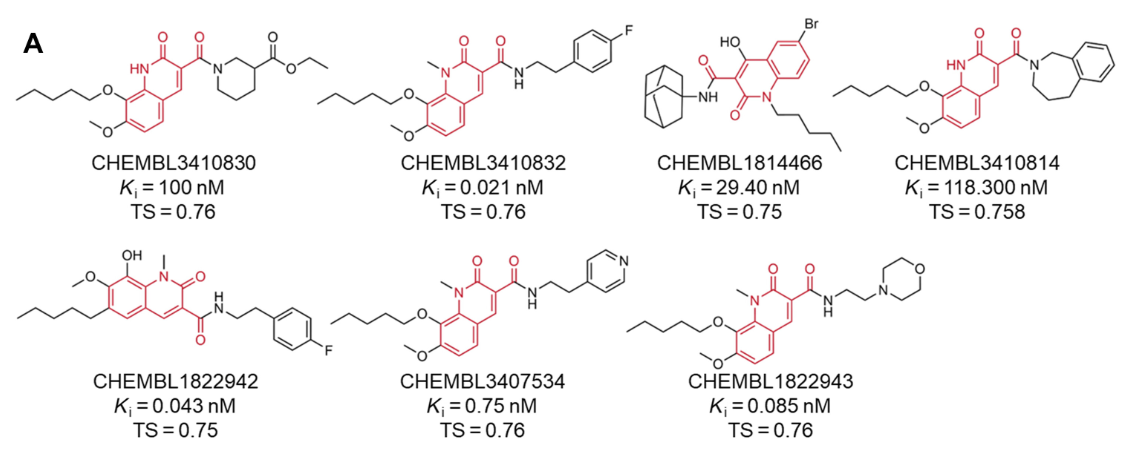
For MCS i, the researchers retrieved and confirmed 49 compounds from the ChEMBL database that contained the predefined substructure and had TS ≥ 0.75 with the generated molecular fingerprint queries. As shown below, 7 compounds have been reported to have high CB2 activity (Ki less than 10 μM).
In the ZINC database, researchers retrieved and confirmed 32 compounds containing the MCS i substructure with TS ≥ 0.75; some representative candidate compounds and their corresponding TS values are shown in the figure below:
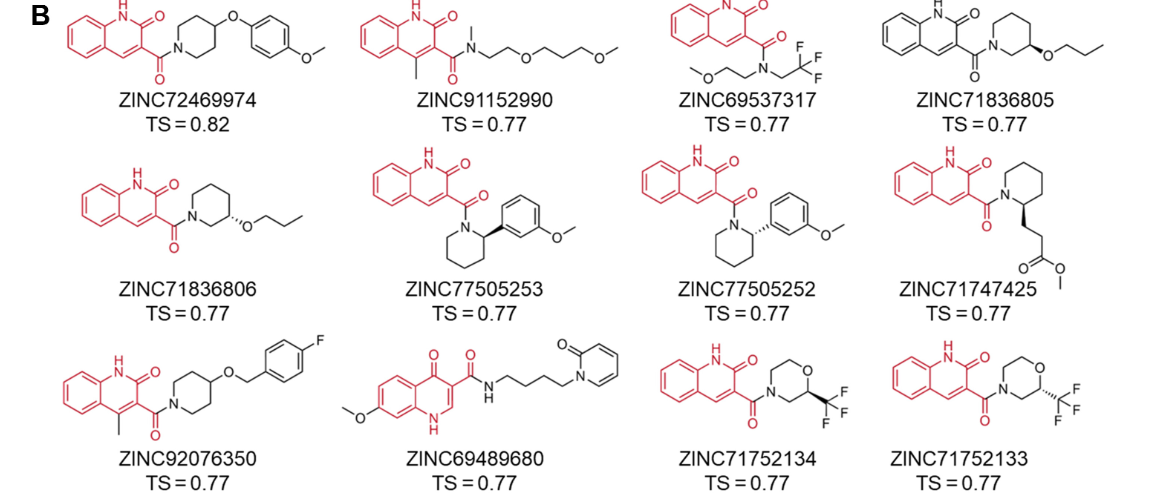
Most of these candidate compounds have predicted molecular docking scores with CB2 that are better than those with CB1, suggesting that they may exhibit a CB2-binding preference in the molecular docking-based prioritization of candidate compounds.
MCS ii: Indolecarboxamide core structure
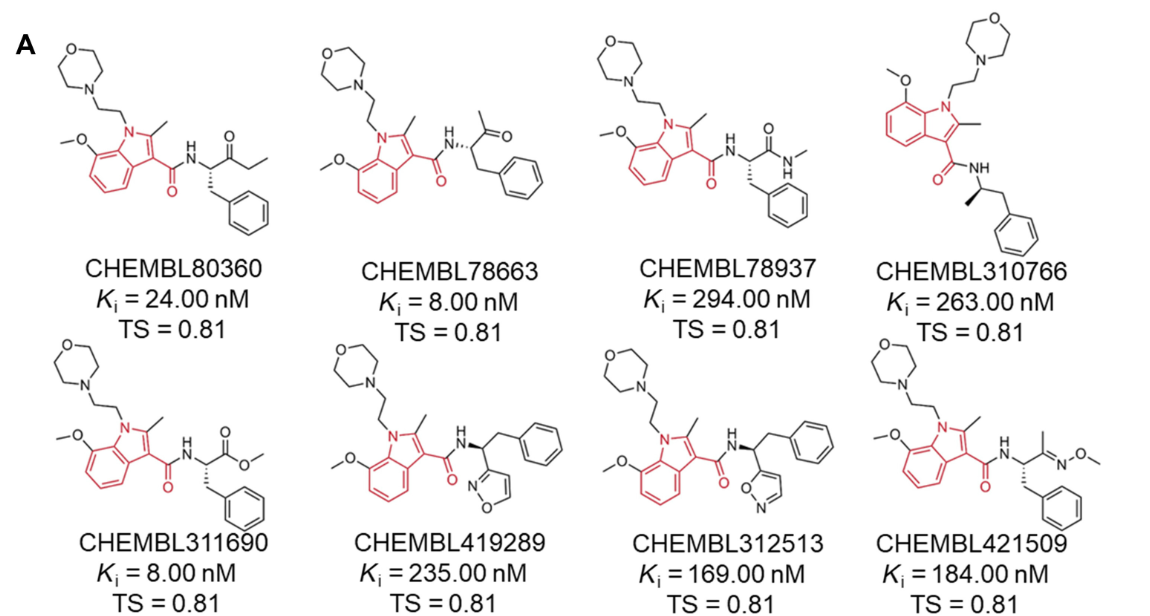
For MCS ii, researchers retrieved and confirmed 24 compounds from the ChEMBL database that contained the predefined substructure and had TS ≥ 0.80 with the generated molecular fingerprint query. Among them, 8 compounds showed strong CB2 binding affinity (as shown below), further demonstrating that the scaffold-constrained DRUG-GAN strategy can effectively retrieve CB2-related chemical structural types.
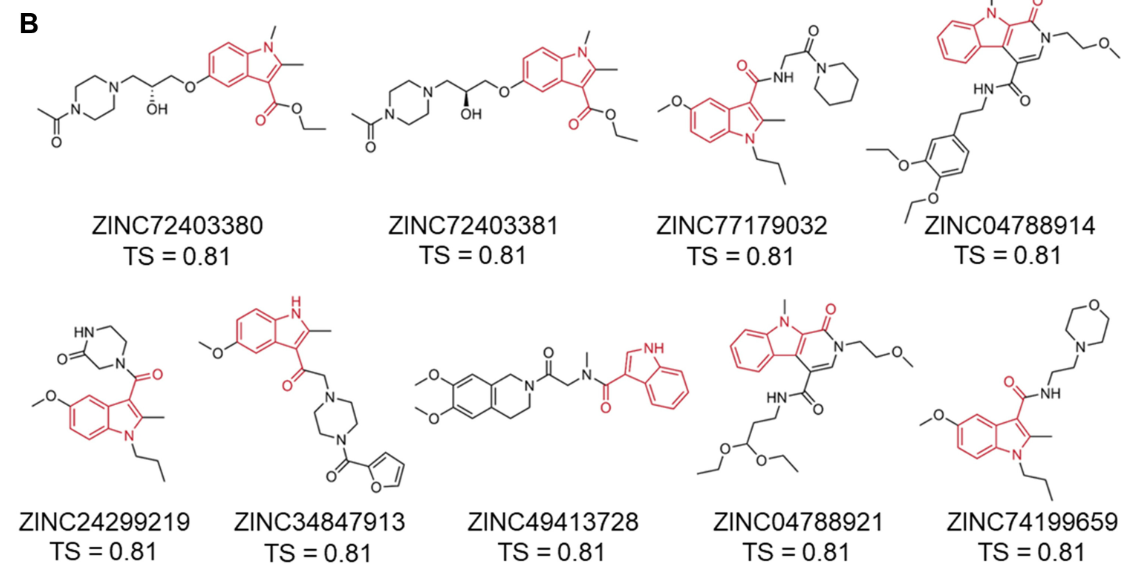
In the ZINC database, researchers identified 9 compounds containing the MCS ii substructure with TS ≥ 0.80 (as shown below). Similar to the candidate compounds for MCS i, most of these compounds also had predicted molecular docking scores with CB2 that were better than their docking scores with CB1, indicating their potential for further CB2-targeted screening.
MCS iii: Indole sulfonamide scaffold
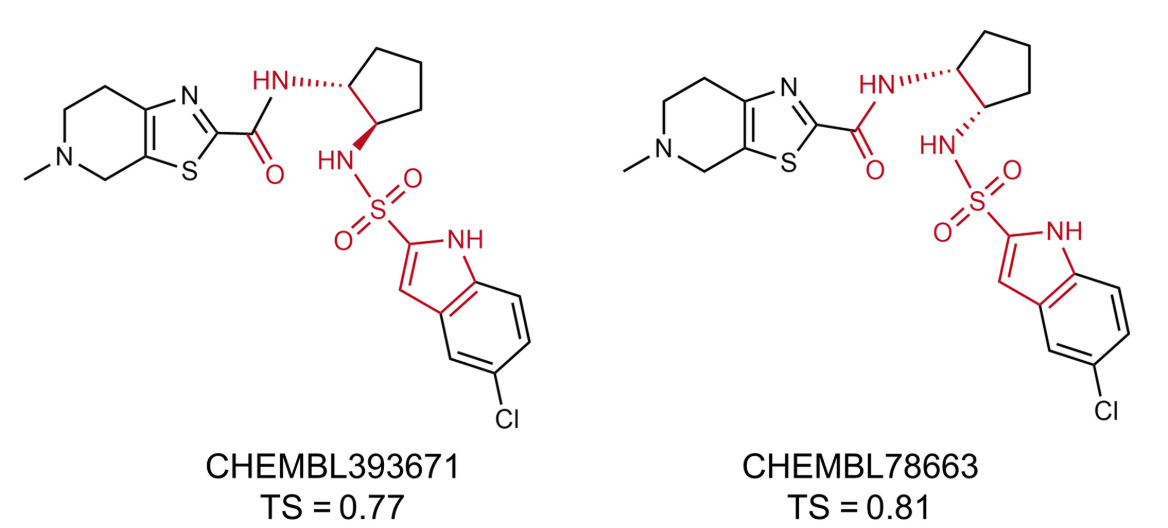
For MCS iii, researchers initially retrieved 165 compounds from the ChEMBL database under the condition TS ≥ 0.75. However, through FP2 molecular fingerprint analysis, only 2 compounds were ultimately confirmed to contain a fully matching MCS iii substructure (as shown below).
In addition, in the ZINC database, all retrieved compounds with TS ≥ 0.75 failed validation, meaning that no compound was confirmed to contain a fully matching MCS iii substructure.
The combined results demonstrate that the scaffold-constrained DRUG-GAN strategy can expand the chemical space represented by the training ligands while preserving CB2-related chemical structural features, thereby discovering new candidate compounds with structural diversity.
Conclusion
To prioritize screening of promising candidate compounds, FSGLD employs a hierarchical workflow to evaluate retrieved compounds, including molecular docking, target-specific LRIP scoring, molecular dynamics (MD) simulations, MM-PBSA binding free energy calculations, and thermodynamic integration calculations, and conducts experimental validation for selected candidate compounds. By integrating these complementary methods into a unified workflow, FSGLD establishes a practical research framework for prioritizing candidate lead compounds and providing a basis for subsequent experimental evaluation.
As protein structure prediction and co-folding methods continue to develop, researchers expect the accuracy, robustness, and applicability of the FSGLD framework to improve accordingly. Future studies will further evaluate DRUG-GAN and FSGLD across a broader range of target families, including ion channels and nuclear receptors, while introducing advanced few-shot learning and small-dataset learning strategies to further improve model performance in data-limited scenarios.
References: