Command Palette
Search for a command to run...
Feature Based Fuzzy Rule Base Design for Image Extraction
Feature Based Fuzzy Rule Base Design for Image Extraction
Koushik Mondal Paramartha Dutta Siddhartha Bhattacharyya
Image Feature Extraction
Abstract
In the recent advancement of multimedia technologies, it becomes a major concern of detecting visual attention regions in the field of image processing. The popularity of the terminal devices in a heterogeneous environment of the multimedia technology gives us enough scope for the betterment of image visualization. Although there exist numerous methods, feature based image extraction becomes a popular one in the field of image processing. The objective of image segmentation is the domain-independent partition of the image into a set of regions, which are visually distinct and uniform with respect to some property, such as grey level, texture or colour. Segmentation and subsequent extraction can be considered the first step and key issue in object recognition, scene understanding and image analysis. Its application area encompasses mobile devices, industrial quality control, medical appliances, robot navigation, geophysical exploration, military applications, etc. In all these areas, the quality of the final results depends largely on the quality of the preprocessing work. Most of the times, acquiring spurious-free preprocessing data requires a lot of application cum mathematical intensive background works. We propose a feature based fuzzy rule guided novel technique that is functionally devoid of any external intervention during execution. Experimental results suggest that this approach is an efficient one in comparison to different other techniques extensively addressed in literature. In order to justify the supremacy of performance of our proposed technique in respect of its competitors, we take recourse to effective metrics like Mean Squared Error (MSE), Mean Absolute Error (MAE) and Peak Signal to Noise Ratio (PSNR).
One-sentence Summary
The authors propose a feature-based fuzzy rule-guided technique for image extraction that operates without external intervention and demonstrates superior efficiency compared to existing methods, as validated by mean squared error, mean absolute error, and peak signal-to-noise ratio metrics.
Key Contributions
- The paper introduces a feature-based fuzzy rule-guided segmentation technique that autonomously partitions images without requiring external intervention or domain-specific preprocessing.
- The method integrates red, green, blue, mean intensity, and standard deviation values as inputs to a Fuzzy Rule Base System that generates interpretable membership functions to handle noisy data and intensity variations.
- Experimental evaluations demonstrate that the proposed framework outperforms conventional segmentation approaches, as validated by superior performance across Mean Squared Error, Mean Absolute Error, and Peak Signal to Noise Ratio metrics.
Introduction
Image segmentation and feature extraction serve as foundational steps for critical applications ranging from medical imaging to autonomous navigation, where reliable preprocessing directly determines downstream accuracy. Traditional thresholding and histogram-based methods, while computationally simple, struggle with intensity variations and noise, often requiring extensive manual tuning or heavy mathematical preprocessing. To address these limitations, the authors leverage a feature-driven fuzzy rule base system that automatically constructs membership functions from standard image statistics like RGB values, mean, and standard deviation. This approach eliminates the need for external intervention, effectively handling uncertain or noisy data while maintaining high interpretability and outperforming conventional techniques across standard error and quality metrics.
Method
The authors leverage a fuzzy image processing framework designed to enhance segmentation robustness by integrating multiple thresholding techniques through a rule-based system. The overall architecture begins with an input image, which is processed by a feature extractor to derive pixel-level attributes such as color components, mean, and standard deviation. These features are then fed into an inference engine that operates on a fuzzy rule base. The inference engine applies fuzzy logic reasoning to determine segmentation decisions based on the extracted features and predefined rules. The output of the inference process is a fuzzy representation of the image, which is subsequently defuzzified to produce a segmented image.
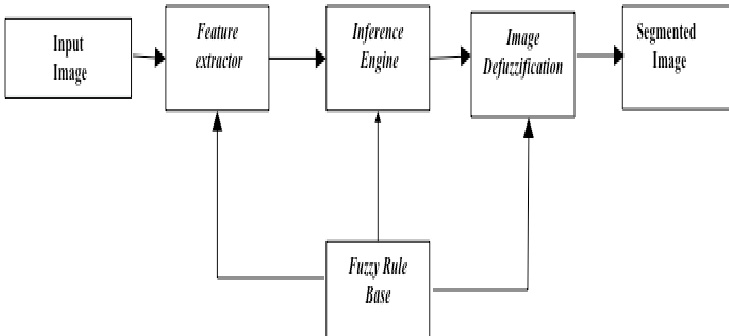
As shown in the figure below, the system incorporates a feedback loop from the fuzzy rule base to the feature extractor, enabling adaptive refinement of feature representation based on the rule base's knowledge. This feedback mechanism supports the integration of multiple thresholding methods by allowing the system to dynamically adjust feature evaluation based on the combined results of different thresholding algorithms. The fuzzy rule base is constructed by mapping threshold values obtained from various methods into corresponding fuzzy regions, forming a combined rule base that governs the inference process. The defuzzification step converts the fuzzy output into a crisp segmented image, effectively translating the fuzzy logic decisions into a final segmentation result. This design emphasizes the integration of numerical data from diverse thresholding techniques into a unified fuzzy framework, enabling a robust and adaptive segmentation approach without requiring iterative training.