Command Palette
Search for a command to run...
Accurate, Interdisciplinary and Transparent Structure-property Understanding with Deep Native Structural Reasoning
Accurate, Interdisciplinary and Transparent Structure-property Understanding with Deep Native Structural Reasoning
Abstract
Structure–property relationships are foundational to biology, chemistry and materials science, where function, reactivity and physical response emerge from spatial, chemical and periodic organization. Mechanistically explaining these relationships requires interpreting structural evidence through scientific principles and physical constraints, from stereochemistry and bonding to symmetry, energetics and periodic order. However, applying artificial intelligence to this process presents a joint challenge of representation and reasoning: models must preserve domain-native structural information while showing how specific evidence supports predictions under these constraints. Here we introduce SciReasoner, a multimodal scientific foundation model for native structural reasoning across proteins, small molecules and inorganic crystals. SciReasoner discretizes coordinates, topologies and periodic connectivities into a unified structure-aware vocabulary, treating structural tokens as addressable evidence units within autoregressive reasoning trajectories. We evaluate SciReasoner in settings where shortcut correlations are weakened and structure-grounded inference is essential. In homology-controlled Gene Ontology prediction, SciReasoner improves Cellular Component annotation for low-homology and orphan-like proteins, increasing Fmax from 0.42 to 0.55. In chemistry, it raises single-step retrosynthesis accuracy from 0.63 to 0.72 while generating fragment-level disconnection and precursor-verification traces. In materials science, its representations separate elemental and compound phases and resolve highand low-band-gap regimes. Across 86 benchmarks, SciReasoner achieves state-of-the-art performance on 67 tasks. Double-blind expert evaluation rates its reasoning traces as preferred or at least comparable to those of a frontier large language model in 98% of cases. By making structure an inspectable substrate for reasoning under scientific constraints, SciReasoner connects accurate prediction with interpretable scientific inference.
One-sentence Summary
Researchers from Shanghai Artificial Intelligence Laboratory, The Chinese University of Hong Kong, and partners introduce SciReasoner, a multimodal scientific foundation model that unifies structural tokens from proteins, small molecules, and inorganic crystals into autoregressive reasoning, boosting Gene Ontology Fmax from 0.42 to 0.55, single-step retrosynthesis accuracy from 0.63 to 0.72, and achieving state-of-the-art performance on 67 of 86 benchmarks, with reasoning traces preferred in 98% of double-blind expert evaluations.
Key Contributions
- SciReasoner is a multimodal foundation model that discretizes three-dimensional coordinates, molecular topologies, and crystallographic lattices into a unified structure-aware vocabulary, treating structural tokens as addressable evidence units within autoregressive reasoning trajectories.
- Across proteins, small molecules, and inorganic crystals, it improves accuracy on structure-grounded tasks: it raises Cellular Component annotation Fmax for low-homology proteins from 0.42 to 0.55, boosts single-step retrosynthesis accuracy from 0.63 to 0.72, and separates elemental and compound phases as well as band-gap regimes, achieving state-of-the-art performance on 67 of 86 benchmarks.
- The generated reasoning traces are inspectable and explicitly ground intermediate claims in structural evidence, and double-blind expert evaluation rates these traces as preferred or comparable to those of a frontier large language model in 98% of cases.
Introduction
Understanding how the spatial, chemical, and periodic organization of matter gives rise to function, reactivity, and physical properties is central to protein annotation, chemical synthesis, and materials discovery. Yet current AI systems rarely combine native structural representation with explicit, evidence-linked reasoning: large language models compress structure into text, losing addressable physical grounding, while domain-specific models output predictions without exposing intermediate evidence. The authors introduce native structural reasoning and instantiate it in SciReasoner, a multimodal foundation model that discretizes proteins, small molecules, and inorganic crystals into a unified structure-aware vocabulary. This design lets structural tokens serve as inspectable evidence units within generated reasoning trajectories, bridging accurate prediction and interpretable scientific inference across biology, chemistry, and materials science.
Dataset

The authors construct a multimodal scientific pretraining corpus by combining five data components, each sourced from public repositories and processed to avoid leakage with downstream benchmarks. The dataset is used for continued pretraining of a single model, interleaving modalities through special structural tags.
-
Protein data
-
Sources: PDB–UniProt mappings (via SIFTS), UniProtKB/Swiss-Prot annotations, PubMed/PMC literature, and AlphaFoldDB for predicted structures.
-
Processing: Each protein is represented as a primary amino acid sequence wrapped in
<protein></protein>tags and a parallel structural sequence wrapped in<protein_structure></protein_structure>tags. The structural sequence is built from residue-level Foldseek 3Di tokens that describe the local 3D environment. Regions with pLDDT < 70 are masked or replaced with a special token to reduce noise. -
Filtering: All text-linked protein records with >30% MMseq2 sequence identity to any protein in the held-out test sets of downstream benchmarks are excluded to prevent label leakage.
-
Usage: The model learns from both the amino acid sequence and the predicted 3D structure in an interleaved protein–text setting.
-
Small-molecule data
-
Sources: Text from US Chemistry Olympiad problems, Europe PMC, ChemRxiv, bioRxiv, medRxiv, and arXiv (chemistry-focused). Structured property data from MoleculeNet, Therapeutics Data Commons, ChEBI, PubChem BioAssay, Tox21, hERG, CYP, CHEMDNER, and other ADMET/toxicity corpora. Reaction and spectral data from ORD, USPTO, Buchwald-Hartwig, Rhea, MOSES, MoNA, and spectrum-reasoning datasets. 3D conformers from ChEMBL and BindingDB.
-
Processing: Molecular property datasets are converted into language-interfaced templates pairing a molecule with its properties. Conformers are generated with RDKit and represented in a sequence-compatible format that combines connectivity with internal coordinates, wrapped in
<molecule_structure></molecule_structure>tags. -
Filtering: Identifiers are canonicalized, and any pretraining examples whose molecule–label or reaction product entries overlap with held-out test sets are removed.
-
Usage: The model sees textual descriptions, property labels, reaction data, and explicit 3D conformations to learn molecular geometry within a language-modeling framework.
-
Materials data
-
Sources: Materials Project, JARVIS-DFT, SNUMAT, hMOF, QMOF, OQMD, OMDB, JARVIS-QETB, GNoME, and Cantor HEA, covering inorganic crystals, semiconductors, MOFs, organic materials, and high-entropy alloys.
-
Processing: Each material is stored with chemical formula, elemental composition, CIF crystal structure, and natural-language structural descriptions. Templates link these representations into training samples.
-
Filtering: A random 80/10/10 split is applied at the material-sample level. All validation and test material samples, including all their property records, are completely removed from the pretraining corpus.
-
Usage: The model learns composition-level, geometry-level, and text-level representations of periodic systems.
-
DNA/RNA data
-
Sources: RNA sequences from RNAcentral; DNA sequences from NCBI.
-
Processing: RNA sequences are kept in FASTA format and wrapped in
<rna></rna>tags, with available metadata (e.g., RNA family) appended. DNA sequences are sampled into 1,000-bp fragments per organism, stored in FASTA, wrapped in<dna></dna>tags, and annotated with organism name and genomic coordinates. -
Filtering: No explicit filtering beyond the sampling strategy is described.
-
Usage: These sequences provide genomic and transcriptomic context for the model.
-
General text and instruction-following data
-
Sources: General web text from the quality-filtered Nemotron-CC v2 (multi-trillion-token Common Crawl derivative). Reasoning instruction data from the mathematics and instruction-following splits of Dolci-Think-SFT-32B, which include explicit
thinkingdelimited deliberation traces. Scientific instruction data from the training split of SciIF, which imposes verifiable constraints over scientific contexts. -
Processing: The data is used as-is, with the instruction–response pairs retaining their formatted reasoning traces.
-
Usage: These corpora complement the scientific data with general-domain language and structured instruction-following supervision.
All components are combined for continued pretraining; the exact mixture ratios are not disclosed except for the materials split, while filtering rules ensure that no benchmark test information leaks into the training corpus.
Method
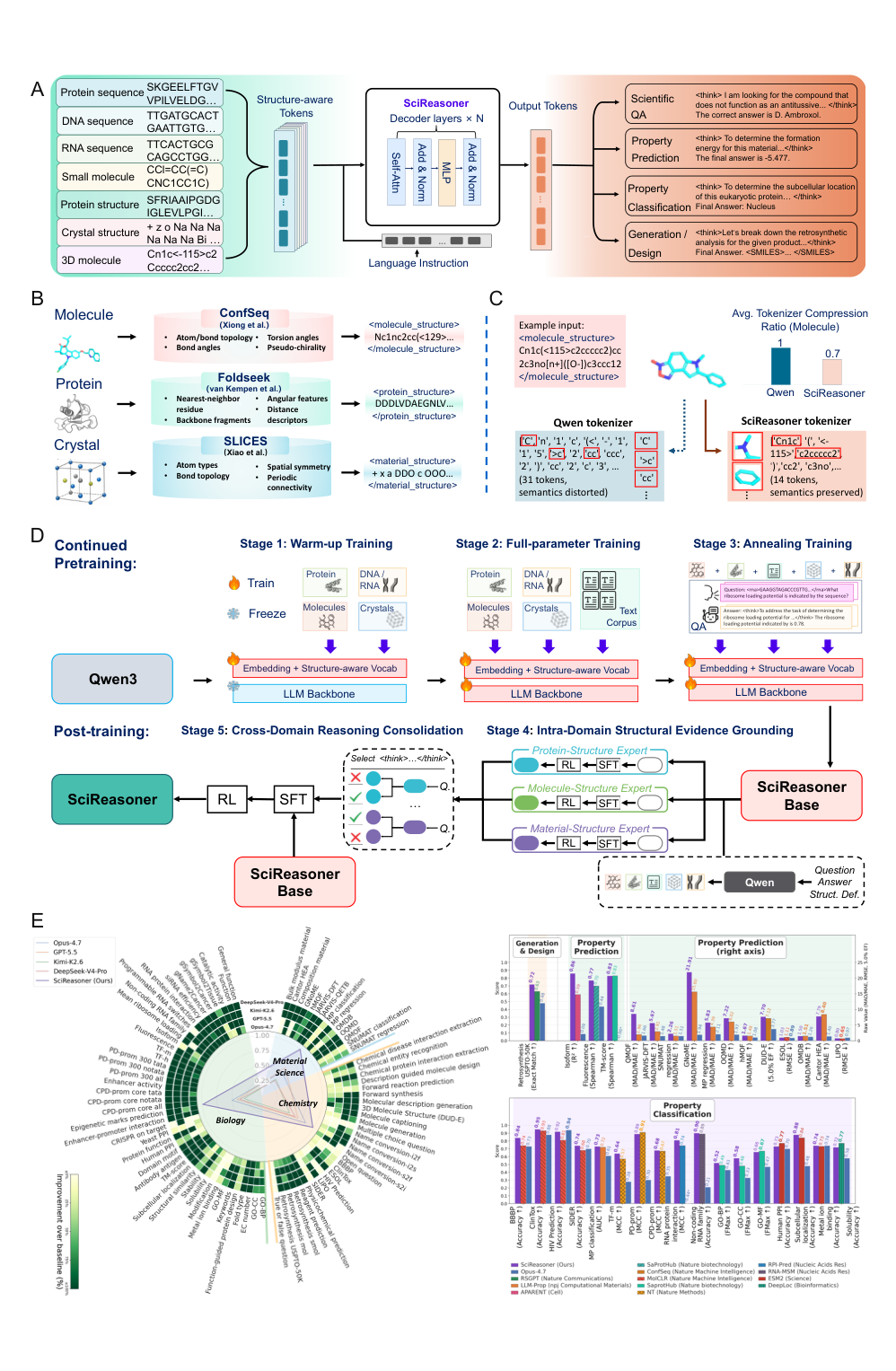
The authors introduce SciReasoner, a multimodal scientific foundation model designed to perform native structural reasoning across proteins, small molecules, and inorganic crystals. Unlike systems that treat scientific entities as text strings or low-dimensional descriptors, SciReasoner represents three-dimensional structures as primary objects of inference through a unified architecture that combines offline structural encoding, a structure-aware vocabulary embedding, and a large language model backbone.
The overall architecture consists of three components: modality-specific offline structural compressors, a structure-aware vocabulary embedding layer that acts as a discrete cross-modal projection, and a unified autoregressive language model backbone fϕ, which is initialized from Qwen3-14B. The design avoids arbitrary fragmentation of physical topologies by subword tokenizers. Instead, each raw structure input S∈{Sprot,Schem,Scryst} is first processed by a domain-specific discrete encoder: Foldseek for proteins, SLICES for crystals, and ConfSeq for small molecules. These encoders serialize the 3D coordinates, molecular topologies, and crystallographic lattices into holistic structural tokens that preserve fundamental physical semantics. The resulting structural sequence Xv is tagged with the appropriate modality tag (e.g., <protein_structure>, <molecule_structure>, <material_structure>).
A key innovation is the structure-aware vocabulary embedding. Rather than employing heavy continuous encoders such as graph neural networks during inference, the model projects the discrete structural token sequence directly into the LLM’s hidden space via a learnable embedding matrix Wv∈R∣Vv∣×dLLM, where ∣Vv∣ is the size of the structural vocabulary and dLLM is the LLM’s hidden dimension. The embedding lookup
Hv=Embedding(Xv,Wv)∈RLv×dLLMtransforms the structural tokens into a dense continuous representation that seamlessly aligns with the language model’s semantic space, bypassing the computational bottleneck of continuous spatial encoders.
The language instruction Xq is tokenized and embedded by the LLM’s native embedding layer to produce Hq. The structural and language embeddings are concatenated along the sequence dimension to form the unified prompt Hprompt=[Hv;Hq]. The LLM backbone then generates the response sequence Xa in an autoregressive fashion, conditioned on both the structural evidence and the textual instruction.
The multi-stage pretraining strategy is optimized with a single autoregressive next-token prediction objective. Given a structural input Hv and a language instruction Hq, the model minimizes the negative log-likelihood of the target response tokens:
LNTP=−t=1∑TlogPϕ(xa,t∣xa,<t,Hv,Hq).The training proceeds in three stages with distinct parameter freezing and learning rate schedules. In Stage 1 (Warm-up), only the structure-aware vocabulary layer, the LLM textual token embeddings, and the prediction head are updated; the core transformer backbone remains frozen. This anchors the newly introduced structural tokens in the embedding space without disrupting the model’s pre-trained reasoning capabilities. Stage 2 (Full-parameter Training) unfreezes all parameters ϕ=Θ and trains the model on diverse paired structure-text data. A shared Warmup-Stable-Decay (WSD) learning rate scheduler is initialized for both Stage 2 and Stage 3, with the learning rate η(t) defined by
η(t)=⎩⎨⎧ηmax⋅Twtηmaxfdecay(t)if 0≤t<Twif Tw≤t<Tw+Tsif Tw+Ts≤t≤Ttotal,where Tw, Ts, and Td denote the durations of warmup, stable, and decay phases. Stage 2 spans the warmup and the initial portion of the stable phase, allowing the full network to absorb domain-specific knowledge at a high constant learning rate. Stage 3 (Annealing) continues full-parameter optimization and inherits the same scheduler; it eventually enters the decay phase and increases the proportion of question-answer-style data to refine the model’s behavior.
To convert the pretrained model into an instruction-following reasoner, the authors devise a two-stage post-training pipeline that combines supervised finetuning (SFT) and reinforcement learning (RL). The process is designed to avoid destructive interference among heterogeneous scientific tasks and to replace external teacher supervision with on-policy reasoning traces.
The coldstart SFT phase re-establishes a dual-mode response protocol: a thinking mode, where the model generates a chain-of-thought rationale c enclosed in `` delimiters before the final answer y, and a non-thinking mode, where the deliberation span is empty and the model produces a direct answer. The SFT objective is a response-only masked next-token prediction:
LSFT=−t=1∑TmtlogPϕ(xa,t∣xa,<t,Hv,Hq),where mt=1 only for tokens in Xa and 0 for prompt tokens. This ensures that the optimization focuses on the mapping from instruction to reasoned answer. In the first stage, the task universe is partitioned into J groups, and a base checkpoint M0 is coldstarted independently on each group’s teacher-supplied CoT corpus, yielding specialized experts {Mjcs}. These experts are then further refined through intra-domain structural evidence grounding via RL, after which they generate on-policy reasoning traces. The teacher supervision is replaced by the model’s own verified traces, and a unified coldstart is performed from M0 on the pooled corpus, providing a well-matched initialization for the final consolidation phase.
The RL stage uses the DAPO algorithm with a reward softening scheme to handle tasks whose evaluation goes beyond exact match. Training data are curated by an empirical solve-rate filtering procedure. For each prompt, eight stochastic rollouts are generated, and the empirical solve rate p^(x) is computed. Only examples with p^(x)∈(0.125,0.875) are retained, and a 2,000-example training set is constructed by selecting instances closest to an intermediate success rate of 0.5. This difficulty-centered sampling yields informative gradients and stable improvement. The policy is optimized with a PPO-style clipped objective that uses within-group standardized advantages and an asymmetric clip-higher schedule to preserve exploration. The RL procedure is first applied per task group (intra-domain structural evidence grounding) to produce a set of experts, and then executed once more on the merged all-task pool (cross-domain reasoning consolidation), starting from the unified coldstart checkpoint. This final pass consolidates the specialized competences into a single unified model capable of explicit structural reasoning across scientific modalities.
Experiment
SciReasoner, a unified multimodal model, demonstrates that integrating sequence, structure, and text reasoning across proteins, DNA/RNA, small molecules, and crystals yields state-of-the-art performance, consistently matching or exceeding domain specialists while providing interpretable, structure-grounded chains of thought. The model's gains are most pronounced in low-homology regimes and tasks requiring explicit 3D reasoning, and ablation studies confirm that structural evidence is essential for its native reasoning capabilities. Through a self-bootstrapped post-training framework, intra-domain grounding and cross-domain consolidation improve both accuracy and reasoning quality, and human experts overwhelmingly prefer SciReasoner's outputs over generalist LLMs for their faithfulness, coherence, and domain plausibility.