Command Palette
Search for a command to run...
Boogu-Image-0.1: Boosting Open-Source Unified Multimodal Understanding and Generation
Boogu-Image-0.1: Boosting Open-Source Unified Multimodal Understanding and Generation
Abstract
We introduce Boogu-Image-0.1, an open-source unified multimodal understanding and generation model family, comprising Base, Turbo, Edit, and Edit-Turbo variants. It delivers competitive performance in high-quality text-to-image generation, fast inference, instruction-based editing, and bilingual (Chinese–English) text rendering. Closed-source multimodal systems like Nano-Banana-Pro and GPT-Image-2 achieve strong performance through system-level integration rather than a single model, yet their internal practices remain largely undisclosed. In this work, we demonstrate that targeted improvements in model understanding, data quality, and training pipelines, coupled with agentic inference-time scaling, can substantially enhance generation and editing performance even under highly constrained compute budgets. Comprehensive evaluations show that Boogu-Image-0.1 consistently matches or surpasses other open-source models across standard benchmarks, and achieves results approaching leading closed-source systems. Notably, this is accomplished with only 208.62 million unique images. The base model’s theoretical training cost is only approximately $400K. We share practical discussions that we believe are valuable to the broader research community, and release weights, code, and recipes under Apache 2.0 to advance the open ecosystem for unified multimodal understanding and generation. Our code is available here: https://github.com/Boogu-Project/Boogu-Image.
One-sentence Summary
Boogu Team, Celia Large Model Application Laboratory, Huawei Technologies, and collaborators from several Hong Kong universities introduce Boogu-Image-0.1, an open-source unified multimodal model family with Base, Turbo, Edit, and Edit-Turbo variants that, through improved understanding, data quality, training pipelines, and agentic inference-time scaling, achieves competitive high-quality text-to-image generation, fast inference, instruction-based editing, and bilingual (Chinese–English) text rendering using only 208.62 million unique images and an estimated $400K training cost, matching or surpassing other open-source models on standard benchmarks and approaching leading closed-source systems while releasing weights, code, and recipes under Apache 2.0.
Key Contributions
- Boogu-Image-0.1 is an open-source unified multimodal model family that jointly optimizes image understanding and generation, shifting from text-to-image to requirement-to-image by translating complex user intents into high-fidelity images.
- Targeted improvements in model understanding, data quality, and training pipelines, combined with agentic inference-time scaling, substantially boost generation and editing performance under tight compute budgets, using only 208.62 million unique images and a training cost of approximately $400K.
- Comprehensive evaluations show Boogu-Image-0.1 matches or surpasses other open-source models on standard benchmarks, achieves state-of-the-art open-source results on Qwen-Image-Bench, and approaches closed-source systems like NanoBanana-Pro, with weights, code, and recipes released under Apache 2.0.
Introduction
The authors address a shift in image generation from simple text-to-image toward requirement-to-image, where models must interpret complex user intentions, implicit constraints, and cross-modal cues rather than only a single descriptive prompt. Closed-source systems have excelled at this, but open-source efforts still lag in faithfully translating nuanced instructions, and many critical engineering practices (evaluation, caption design, data filtering) remain opaque, forcing teams to incur costly trial-and-error. The authors contribute Boogu-Image-0.1, an open-source system that makes "understanding" a first-class design target, combining a strong multilingual vision-language text encoder, agentic prompt rewriting with model selection and reflection at inference, and highly cost-effective training on only 208 million images. This integration achieves state-of-the-art open-source performance, bringing open models closer to closed-source quality while documenting the practical details to lower the barrier for future research.
Dataset
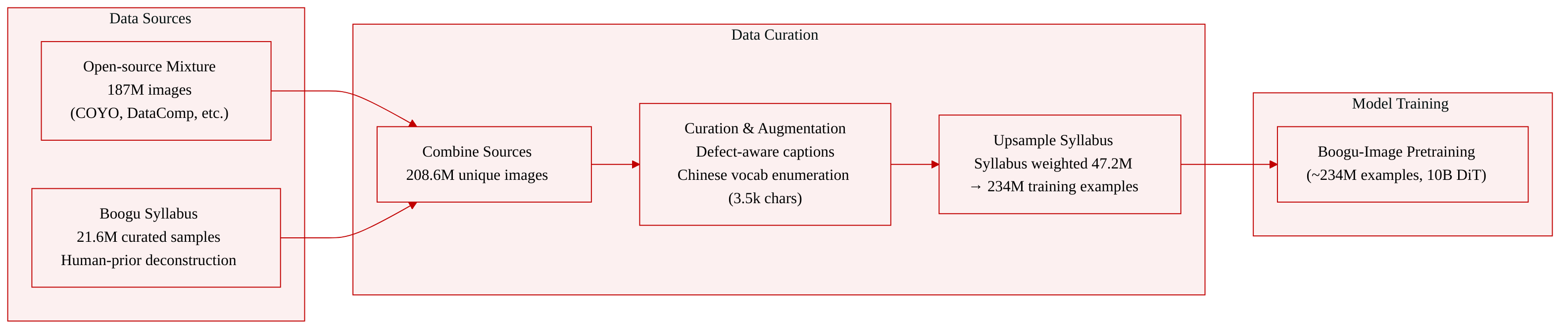
The authors build the training data for Boogu-Image by combining publicly available image-text corpora with a hand-crafted “syllabus.” The final dataset contains 208.62 million unique images, consisting of two main blocks:
- Open-source mixture (187M images) – a collection of single image–text pairs and interleaved text–image documents from COYO, DataComp, PixelProse, BLIP-3o, and OmniCorpus. These captions are often brief and noisy, and the data suffers from duplication and semantic errors.
- Boogu syllabus (21.62M unique samples) – a curated set built according to human priors. It systematically deconstructs visual domains (e.g., graphic design breaks into typography, poster design, logo composition) and injects rare concepts, detailed captions, and negative visual elements. During training this part is upsampled to 47.19M effective examples through predefined weighting ratios, giving extra emphasis to complex, long-tail tasks.
Key processing details
- Flawed images are kept, not filtered. Watermarked, blurry, underexposed, or noisy samples are retained and paired with captions that explicitly name the defect (e.g., “motion blur,” “visible watermark”). This teaches the model both the visual content and the concept of the artifact, enabling controllable generation of or avoidance of such defects.
- Vocabulary enumeration for Chinese text rendering. To generate Chinese characters reliably, each character must appear at least 300 times in the training data. For practical resource limits, the 3,500 most common modern Chinese characters are prioritized and repeatedly included to ensure everyday text rendering.
- Caption quality. Open-source captions are shallow; the syllabus relies on richer, synthetic or human-refined descriptions that capture fine-grained attributes, spatial relations, and defects.
How the data is used The full set (187M open-source images + 21.62M syllabus images) serves as the pretraining data for the Boogu-Image model. In the training mixture, the syllabus samples are upsampled to 47.19M instances, so the model effectively sees about 234M training examples. Experiments show that a model trained with this combined, human-prior-guided data significantly outperforms one trained on the 187M open-source data alone in terms of instruction following, world knowledge, and photographic quality.
Method
The authors propose Boogu, a text-to-image system designed to optimize both generation quality and computational efficiency by placing understanding at the core of its architecture. The framework decomposes the understanding process into three complementary dimensions: interpreting user intent, comprehending training images, and estimating task complexity. This multi-faceted approach addresses common failure modes in text-to-image pipelines, such as ambiguous prompts, insufficient training supervision, and inefficient resource allocation.
To bridge the gap between underspecified user inputs and the structured conditioning required by generation models, the authors employ an agentic prompt rewriter. Unlike traditional rewriters that indiscriminately expand prompts and risk hallucination, this module acts as a translator of intent. It treats rewriting as a reasoning process, resolving ambiguities, handling implicit descriptions, and addressing specific challenges like precise counting, NSFW content filtering, and text rendering. A key design principle is that the rewriter is lower-bounded by the identity transformation. If a prompt is already clear, it remains unchanged, ensuring that rewriting only helps and never degrades the original intent.
The efficacy of this prompt rewriting module is heavily dependent on the underlying Vision-Language Model backbone. Stronger models with richer world knowledge and reasoning capabilities produce significantly more coherent and intent-faithful rewrites.
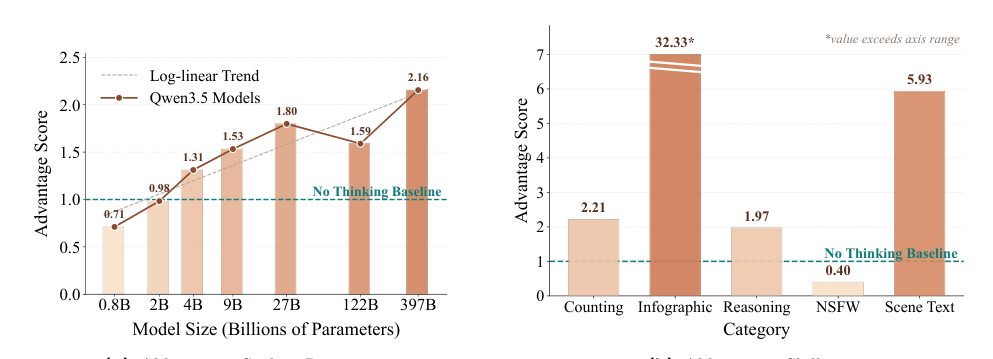
As illustrated in the figure above, there is a clear positive correlation between the model size and the advantage score gained through rewriting. Furthermore, the reasoning-capable rewriter provides substantial performance boosts across various challenging categories, including counting, infographics, general reasoning, NSFW filtering, and scene text rendering.
On the training side, the authors emphasize that captioning strategies fundamentally dictate what a model can learn. To ensure high-fidelity image-caption alignment, they implement a per-aspect captioning pipeline. Instead of relying on a single VLM or system prompt, which often leads to inaccuracies in object counting, spatial relations, or attribute binding, the authors systematically benchmark multiple candidate VLMs. For each specific aspect of interest, they select the model and prompt configuration that yields the best accuracy and aggregate these outputs into a unified, demand-driven caption. For dimensions where even strong VLMs struggle, expert models or human annotators are utilized. This targeted supervision prevents systematic blind spots and injects desired capabilities directly into the model weights.
Finally, to manage the trade-off between quality and efficiency during inference, the system incorporates complexity-aware routing. By explicitly estimating the difficulty of each request, Boogu directs simple tasks to lightweight models and reserves the strongest generators for complex cases requiring deep reasoning or high-fidelity composition, thereby maintaining high average quality while keeping the computational budget under control.
Experiment
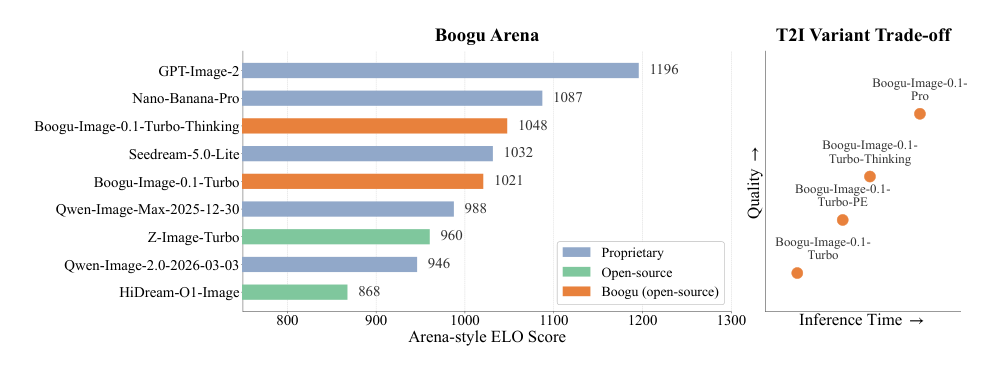
Experiments evaluate text-to-image and image editing capabilities via a custom Boogu Arena using pairwise human Elo ratings, along with several public benchmarks including Qwen-Image-Bench and LongText-Bench. Boogu models consistently outperform open-source baselines and approach top closed-source systems, with the thinking variant delivering notable gains in text rendering and complex editing through explicit reasoning. Qualitative comparisons demonstrate strong prompt alignment, photorealism, and stable dense-text generation, while ablation studies highlight the importance of a capable instruction encoder, a translation-oriented prompt rewriter, syllabus-guided data curation, and 2D-aware guidance. The work also critiques saturated and leaked benchmarks, emphasizing the need for human-aligned, cost-aware, and scenario-driven evaluation to capture real-world utility.
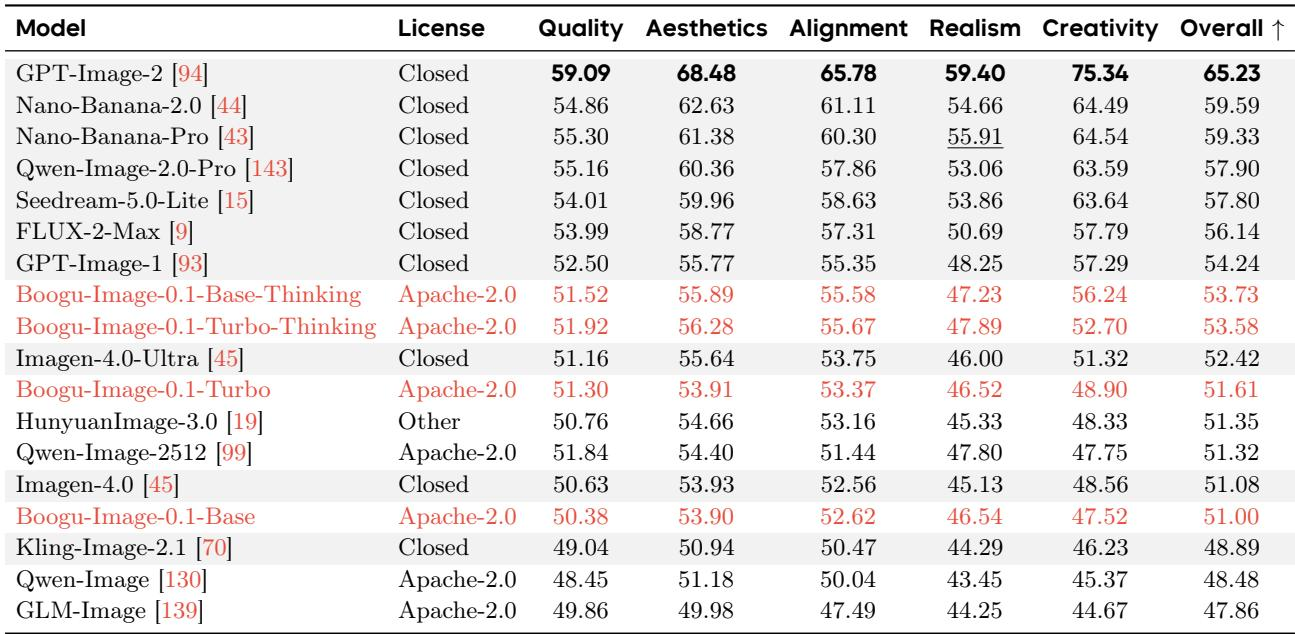
Among open-source models evaluated on Qwen-Image-Bench with Chinese prompts, Boogu-Image-0.1-Base-Thinking achieves the highest overall score, surpassing strong baselines like Qwen-Image-2512 and HunyuanImage-3.0. The thinking variant delivers a major boost in the Creativity dimension, improving by over 8 points compared to the non-thinking version. These gains are consistent across Chinese and English, indicating robust bilingual performance. Boogu-Image-0.1-Base-Thinking leads all open-source models on the Chinese-prompt benchmark. The thinking variant improves Creativity by more than 8 points over the non-thinking counterpart. Performance advantages persist in both Chinese and English, showing strong bilingual capability. The model surpasses open-source baselines such as Qwen-Image-2512 and HunyuanImage-3.0.
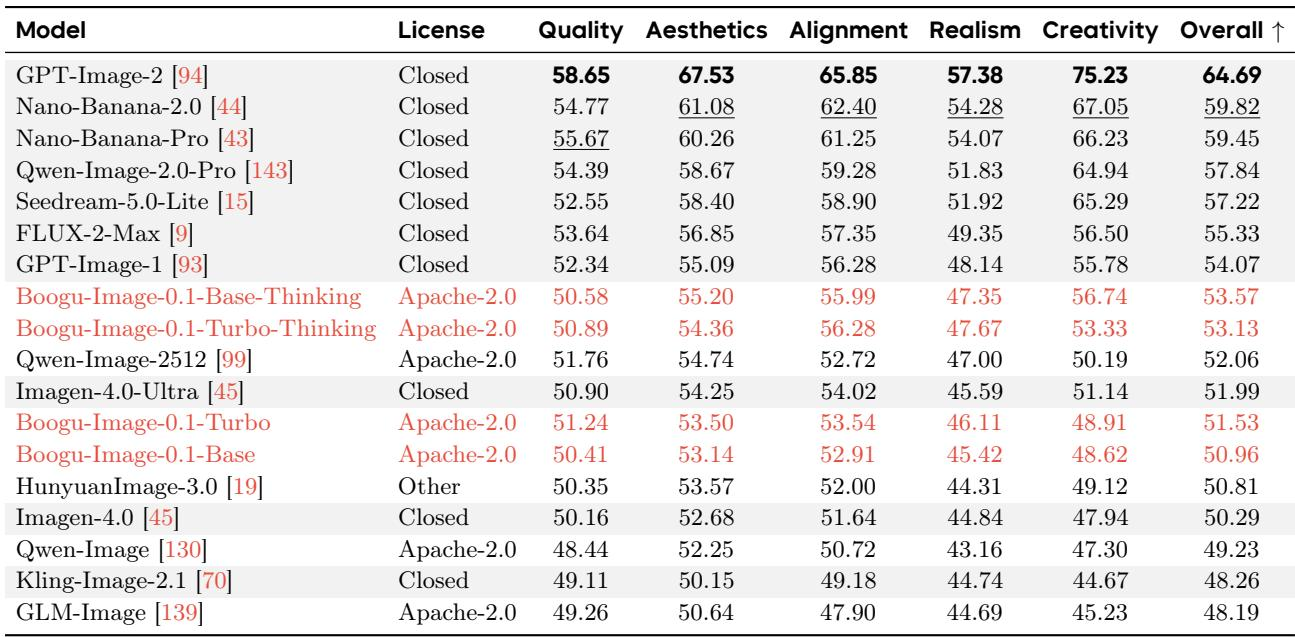
Among open-source models tested on English prompts, Boogu-Image-0.1-Base-Thinking attains the top overall score, surpassing strong baselines like Qwen-Image-2512 and HunyuanImage-3.0. The thinking variant drives a pronounced improvement in the Creativity dimension, aligning with the design focus on understanding and mirroring the same pattern seen in Chinese evaluations. Boogu-Image-0.1-Base-Thinking ranks first among all open-source models on the English Qwen-Image-Bench. The thinking version achieves a large Creativity uplift over its non-thinking counterpart, a trend that remains stable across languages.
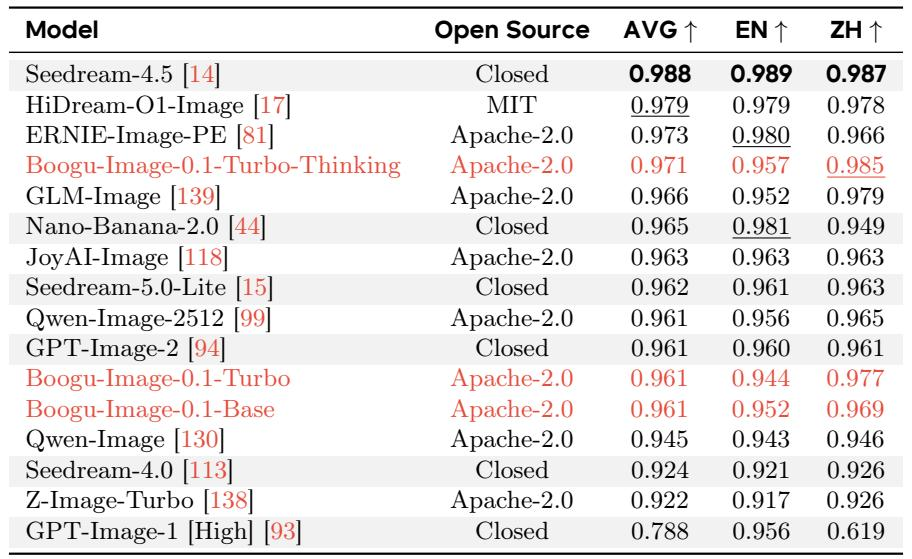
The Boogu-Image model family performs competitively on LongText-Bench, with the Turbo variant achieving the second-highest Chinese score overall and strong average results among open-source models. However, the benchmark heavily rewards OCR-level correctness on short text, causing Turbo to score well despite producing visual artifacts in dense layouts where the Base model actually renders more coherent typography. Boogu-Image-0.1-Turbo-Thinking attains the second-best Chinese score (0.985) across all evaluated systems, behind only the closed-source Seedream-4.5. In dense-text scenarios the Base model yields more coherent text than Turbo, yet Turbo maintains a high benchmark score because the metric mainly checks text accuracy for sequences under 100 characters rather than overall visual quality.
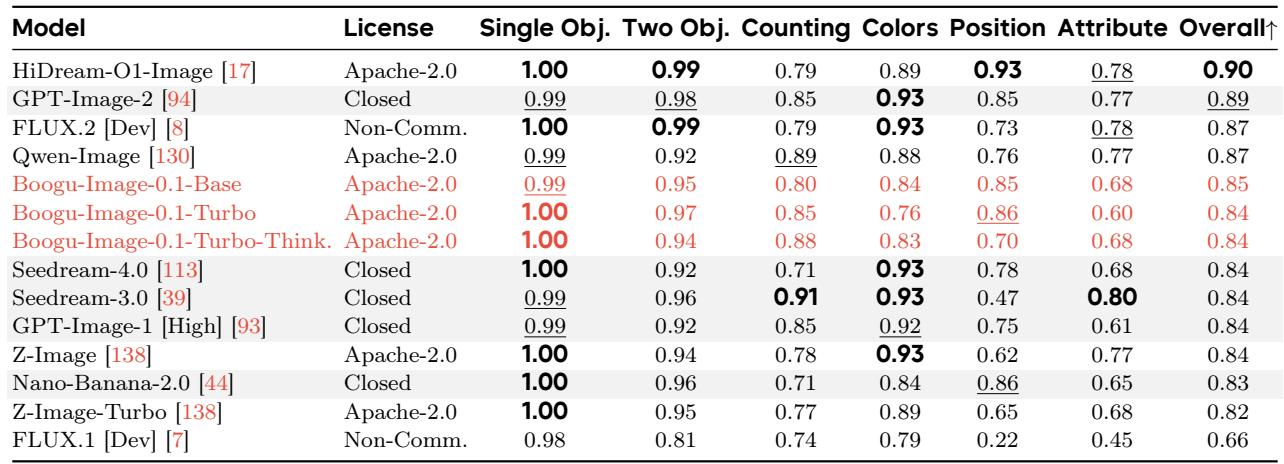
The Boogu-Image models achieve overall GenEval scores between 0.84 and 0.85, placing them slightly behind top systems such as HiDream-O1-Image (0.90) and GPT-Image-2 (0.89). The authors caution that GenEval diverges substantially from human preferences and is not used for primary evaluation, so these results are reported only as supplementary reference. Boogu-Image-0.1-Base, Turbo, and Turbo-Think all cluster within a narrow overall score range (0.84–0.85), with Base marginally ahead. All Boogu variants perform strongly on Single Object (0.99–1.00) and Two Objects (0.94–0.97), but they consistently lag on Attribute (0.60–0.68). Compared to open-source alternatives, Qwen-Image (0.87) and FLUX.2 (0.87) outscore the Boogu series on the overall metric. The paper explicitly states that GenEval has a significant gap from real human preferences and is not adopted for primary evaluation.
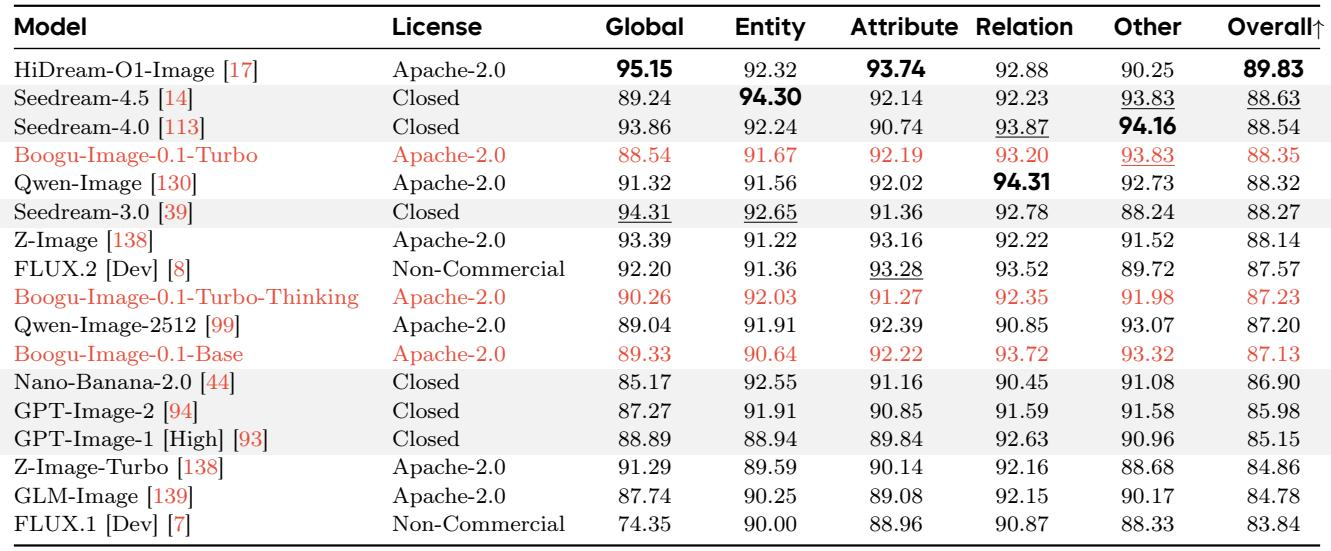
On DPG-Bench, HiDream-O1-Image achieves the highest overall score, followed by a cluster of models with close overall scores. Boogu-Image-0.1-Turbo ranks fourth overall, demonstrating competitive performance particularly in the Relation category, while its Global score is comparatively lower. These results are reported only as a supplementary reference, as DPG-Bench shows a significant gap from real human preferences. HiDream-O1-Image leads the ranking with a large margin in the Global subscore, contributing to its highest overall score. Boogu-Image-0.1-Turbo attains the second-highest Relation score among all models, outperforming several closed-source competitors. The Global category is a relative weak point for Boogu-Image-0.1-Turbo, where it scores lower than every other model except one.
The Boogu-Image models are evaluated across multiple benchmarks, including Qwen-Image-Bench, LongText-Bench, GenEval, and DPG-Bench. The thinking variant consistently boosts creativity scores in both Chinese and English, with the Base-Thinking model achieving the highest overall results among open-source models on Qwen-Image-Bench. On LongText-Bench, the Turbo variant attains a strong Chinese score, but this metric rewards short-text OCR accuracy and overlooks visual artifacts, while the Base model renders more coherent typography in dense layouts. GenEval and DPG-Bench results are supplementary, as the authors note these benchmarks diverge from human preferences; Boogu-Image models perform competitively but not at the top, with strengths in object rendering and relative weaknesses in attribute binding and global composition.