Command Palette
Search for a command to run...
Robust and Efficient Motion Reasoning for Privacy-Aware Classroom Incident Recognition
Robust and Efficient Motion Reasoning for Privacy-Aware Classroom Incident Recognition
Paritosh Parmar Landy Lan Hong Yang Chen Yi Chiat Pin Tay
Abstract
Can computer vision help make classrooms safer? In this pilot study, we investigate privacy-aware and computationally efficient classroom incident recognition from CCTVstyle observations. This setting remains underexplored, with limited benchmarks and few methods designed for the privacy, efficiency, and generalization demands of real world deployment. We introduce a novel hybrid benchmark combining generative CCTV-style videos with real-world classroom pose data, and propose a lightweight, but robust motion-reasoning framework motivated by the observation that many incidents differ more in motion direction, speed, acceleration, and intensity than in pose alone. To that end, our method first constructs hierarchical kinematic representations of human actions. Our method then distills hierarchical, multi-order kinematic reasoning from a large teacher into a much smaller single-order student, enabling efficient per-person inference while preserving expressive motion understanding. Experiments show that our model outperforms substantially larger baselines at less than onetenth of their computational cost, while also demonstrating stronger out-of-domain motion reasoning and zero-shot synthetic-to-real generalization. We will publicly release the benchmark, codebase, and supporting tools to facilitate further research in privacy-aware classroom safety.
One-sentence Summary
Researchers from the Institute of High Performance Computing, A*STAR, introduce a hybrid benchmark pairing generative CCTV-style videos with real-world classroom pose data and propose a lightweight motion-reasoning framework that distills hierarchical kinematic reasoning from a large teacher model into a compact single-order student, enabling efficient per-person inference at less than one-tenth the computational cost of larger baselines while demonstrating strong out-of-domain motion reasoning and zero-shot synthetic-to-real generalization for privacy-aware classroom incident recognition.
Key Contributions
- A hybrid benchmark for privacy-aware classroom incident recognition is introduced, combining generative CCTV-style videos with real-world classroom pose data to target rare safety-critical actions such as falls, fights, and running.
- A lightweight motion-reasoning framework is proposed that constructs hierarchical kinematic representations and distills multi-order motion knowledge from a large teacher model into a compact single-order student, enabling efficient per-person inference.
- Experiments show the distilled model surpasses substantially larger baselines at less than one-tenth of the computational cost, and exhibits stronger out-of-domain motion reasoning along with zero-shot synthetic-to-real generalization.
Introduction
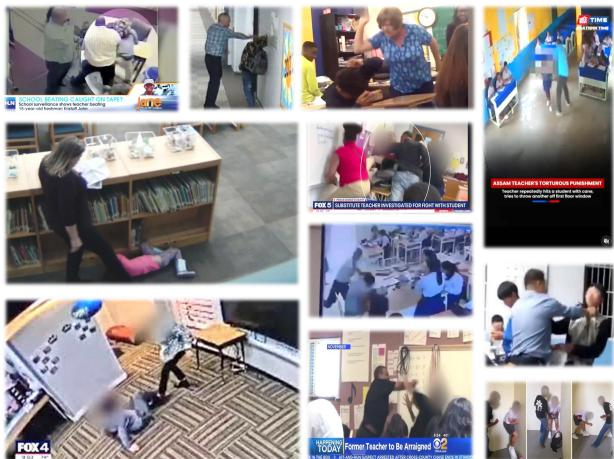
Automated monitoring of classroom safety incidents such as falls, fights, and running is important for timely intervention and accountability, yet manual review of CCTV feeds is error-prone and unsustainable. Prior work in educational computer vision has focused on engagement, attention, and assessment, leaving incident recognition largely unexplored, with no dedicated benchmarks and with challenges like ceiling-mounted camera viewpoints, underrepresented child-adult interactions, and privacy concerns around raw video. The authors address this gap by introducing a CCTV-view classroom incident recognition benchmark that combines synthetic and real videos, and by proposing a lightweight, privacy-preserving framework that operates on skeletal pose data instead of raw images, outperforming existing pose-based baselines while generalizing from synthetic to real-world footage.
Dataset

The authors construct a classroom incident recognition dataset composed of two complementary subsets:
-
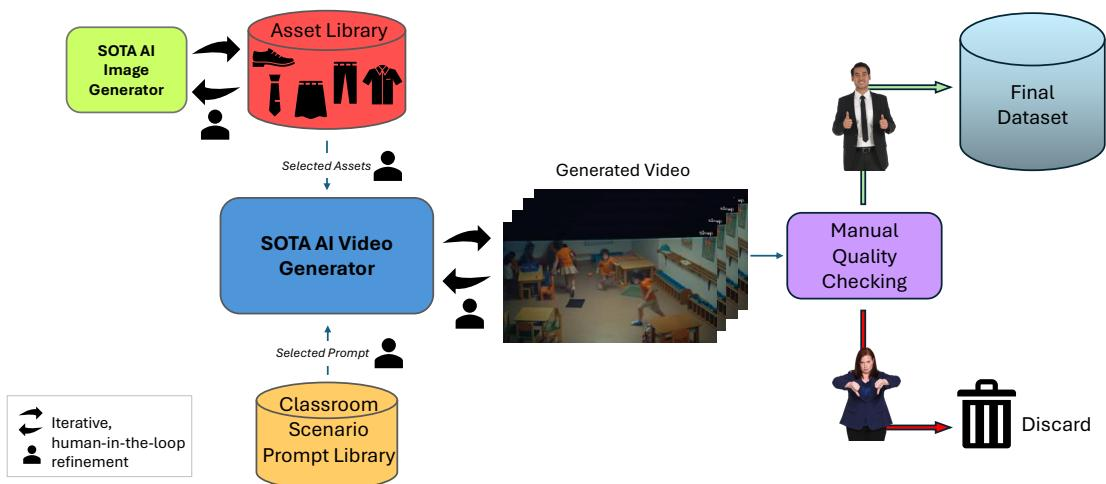
Synthetic video subset (1,296 clips): Generated using a pipeline built on Kling and Seedance video models. Prompts are carefully designed to replicate preschool CCTV footage, including ceiling-mounted camera angles, typical classroom objects, and student sizes. A school uniform asset library is created through human-in-the-loop image generation, with each asset manually verified against real-world uniforms. The pipeline also generates non-uniform variations. Each video undergoes a three-reviewer quality inspection for visual realism, temporal consistency, motion fidelity, and action semantics. Finally, preschool teachers validate the samples, and action labels with temporal boundaries are annotated using a custom toolbox.
-
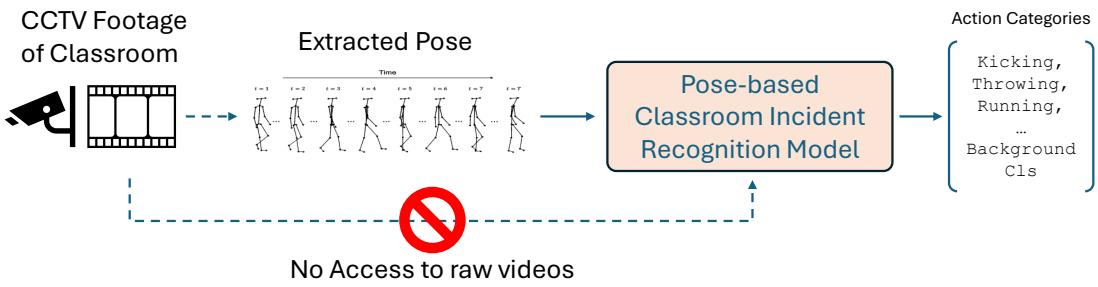
Real-world pose subset (574 sequences): Collected from actual preschools. Only anonymized skeleton keypoints are extracted from CCTV video data; no raw video is released. Action labels and temporal boundaries are annotated with the same toolbox, and all annotations are verified by preschool teachers.
-
Action classes: Seven incident classes (fall, punch, jump, kick, throw, run, sit) and a background meta-class for non-incident classroom activities.
-
How the data is used: The dataset is employed to train and evaluate classroom incident recognition models. The synthetic videos supply diverse, controlled visual examples, while the real-world pose sequences provide authentic motion patterns from genuine classroom settings.
-
Processing details: The annotation toolbox preloads estimated skeleton poses to reduce manual effort. No explicit cropping strategy is applied; the processing focuses on prompt-guided generation, quality inspection, and teacher-led validation. The released dataset includes only synthetic videos and approved real-world pose keypoints, with no personally identifiable information.
Method
To address the challenges of obtaining suitable data for classroom incident recognition, the authors leverage generative AI to produce realistic synthetic videos. The dataset generation pipeline begins with the construction of an asset library, such as school uniforms, using state-of-the-art image generators in a human-in-the-loop process. These assets, along with carefully designed prompts that mimic typical CCTV camera placements and viewing angles, are fed into video generators to conditionally synthesize classroom videos. Each generated video undergoes manual quality inspection by multiple reviewers to ensure visual realism, temporal consistency, and correct action semantics before being added to the final dataset.
The proposed recognition system is designed to identify safety-related incidents from pose sequences alone, reducing reliance on raw visual data and preserving privacy. As shown in the framework diagram, the system processes extracted pose trajectories from CCTV footage without accessing the raw videos, feeding them into a pose-based classroom incident recognition model to predict action categories.
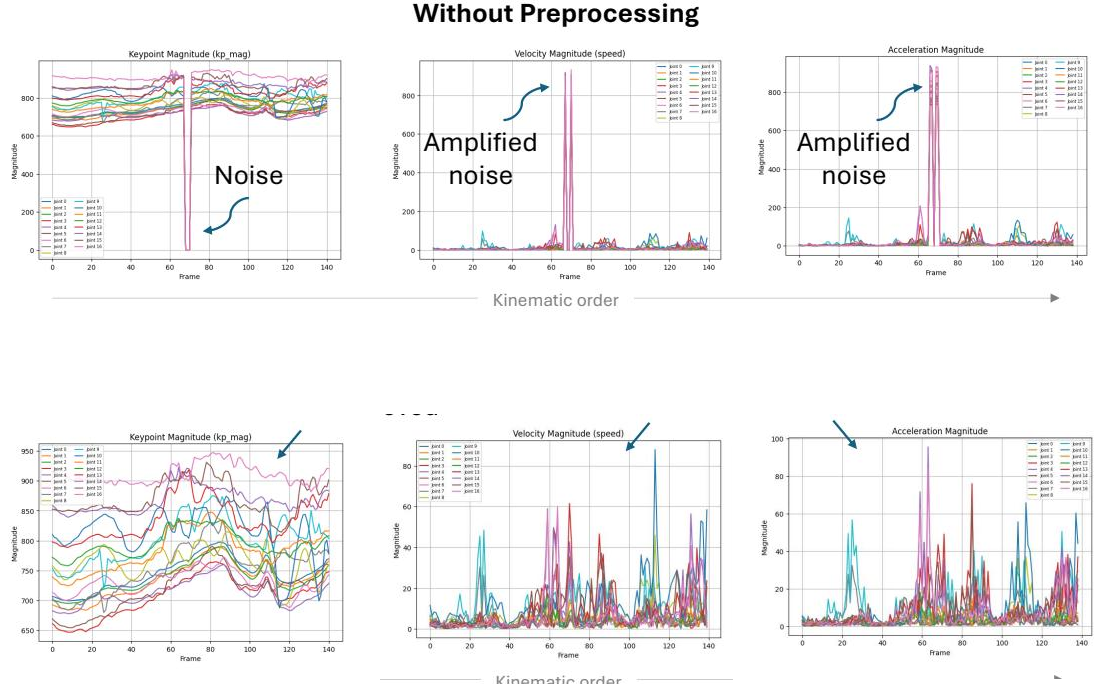
To capture the dynamics of actions, the authors introduce a hierarchical kinematic representation combining joint positions, velocities, and accelerations. However, computing higher-order kinematic features can amplify errors present in lower-order pose estimates. As illustrated in the figure below, naive derivation leads to significant noise amplification in velocity and acceleration magnitudes. To mitigate this, the authors apply temporal preprocessing, including linear interpolation for missing coordinates and a Savitzky-Golay filter for smoothing, before computing the derivatives.
A unified action recognition model is instantiated for each kinematic order, with order-specific backbones trained independently on joint positions, velocities, and accelerations. To obtain a robust joint representation, the latent representations from these backbones are fused using weighted averaging:
ϕmulti−order=∑m=0Mwm∑m=0Mwmϕmwhere M is the number of kinematic orders, ϕm is the representation for order m, and wm is the fusion weight.
To reduce inference cost for deployment on resource-constrained devices, the authors employ a multi-objective knowledge distillation framework. The full approach, visualized in the figure below, distills the multi-order fused teacher model into a lightweight single-stream student model that operates only on zeroth-order joint-position features.
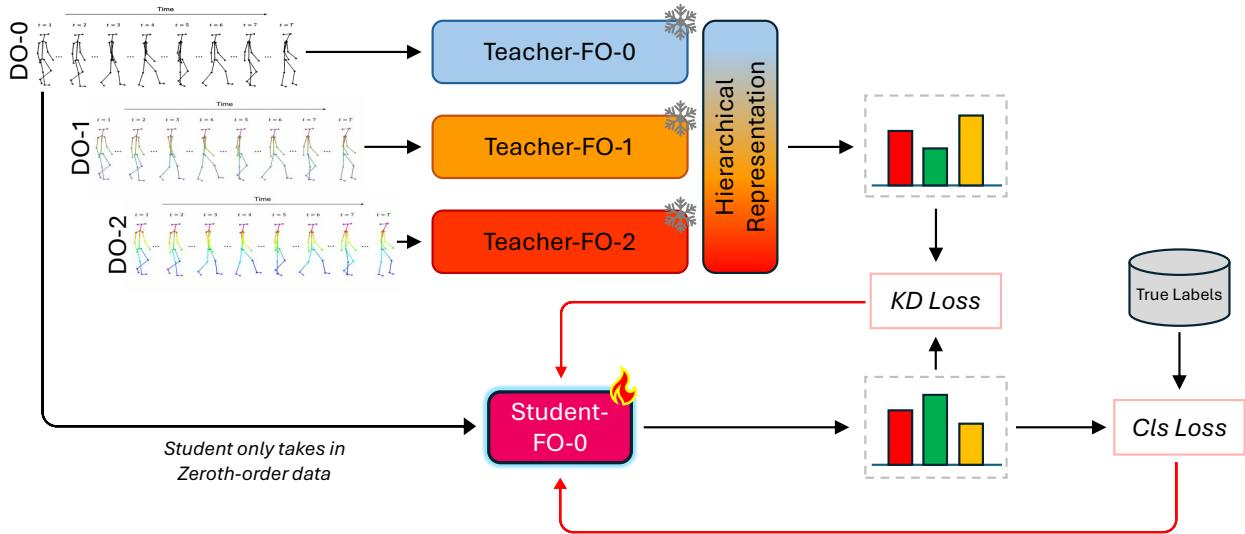
The student model is trained using two complementary objectives. First, a distillation loss based on the Kullback-Leibler divergence aligns the student's softened class-probability distribution with that of the teacher:
LKD(ps(τ),pt(τ))=τ2j∑pjt(τ)logpjs(τ)pjt(τ)Second, a standard classification loss with ground-truth labels preserves direct supervision:
LCls(ps(1),y)=j∑−yjlogpjs(1)The final multi-objective training loss combines these terms:
LMTL=λKDLKD+λClsLClsThis process compresses the model along two axes: from multi-order inputs to a single zeroth-order stream, and from a larger teacher network to a substantially smaller student network.
Experiment
The evaluation uses a synthetic classroom incident dataset to test a teacher-student distillation framework for skeleton-based action recognition, incorporating multi-order kinematic cues like joint positions, velocities, and accelerations. Comparisons with representative methods show that the lightweight student model outperforms heavier baselines, while zero-shot transfer to real-world footage demonstrates stronger cross-domain generalization due to its reliance on motion-sensitive representations rather than visual appearance. Ablation studies confirm that all kinematic orders provide complementary information, and that distilling the multi-order teacher into a compact student allows the student to surpass its larger teacher, with the optimal loss balancing and fusion weights being key to this improvement.
The proposed method achieves the highest accuracy on the synthetic classroom incident dataset, outperforming all baselines including PoseC3D while using only a tenth of its parameters. All models exhibit lower accuracy than on standard benchmarks due to the dataset's cross-subject and cross-view challenges, and the method also leads in zero-shot real-world transfer, though a domain gap remains. Ablation shows that combining joint positions, velocities, and accelerations through multi-order modeling and distillation allows a lightweight student to surpass its teacher. The proposed method attains 71.78% accuracy, surpassing PoseC3D by 1.24 percentage points and MSG3D by 2.90 percentage points. It uses one-tenth as many parameters as PoseC3D yet achieves superior performance. All evaluated methods show substantially lower accuracy on this dataset compared to established benchmarks, highlighting the difficulty of classroom incident recognition. Multi-order motion cues (position, velocity, acceleration) are complementary, and distilling them into a lightweight zeroth-order student enables the student to outperform the larger teacher. In zero-shot real-world evaluation, the method remains the top performer, but accuracy drops from 71.78% to 63.41%, indicating a persistent synthetic-to-real gap.
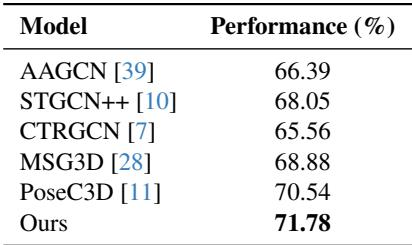
All models experience a drop when transferring from synthetic to real classroom footage, confirming a domain gap. The proposed method achieves the highest zero-shot real-world accuracy, outperforming the strongest baseline by over four percentage points and other baselines by even larger margins, due to pose-based abstraction and multi-order motion distillation. The proposed method reaches 63.41% zero-shot real-world accuracy, exceeding MSG3D by 4.18 percentage points and STGCN++ by 6.09 percentage points. Pose features and multi-order distillation help the model preserve action-relevant motion patterns across the synthetic-to-real shift, yielding the best cross-domain generalization among all compared methods.
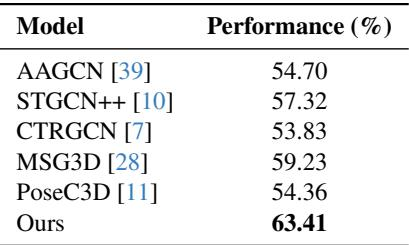
The proposed method is evaluated on a synthetic classroom incident dataset featuring cross-subject and cross-view challenges, and on zero-shot transfer to real classroom footage. It achieves the highest accuracy while using only a tenth of the parameters of the strongest baseline, validating that multi-order motion modeling of joint positions, velocities, and accelerations, combined with distillation into a lightweight student, yields substantial gains. In zero-shot evaluation, the method remains the top performer but accuracy drops, confirming a persistent synthetic-to-real domain gap; nonetheless, pose-based abstraction and multi-order distillation provide the best cross-domain generalization among all compared approaches.