Command Palette
Search for a command to run...
Application of Artificial Intelligence for Fraudulent Banking Operations Recognition
Application of Artificial Intelligence for Fraudulent Banking Operations Recognition
Bohdan Mytnyk Oleksandr Tkachyk Nataliya Shakhovska Solomiia Fedushko Yuriy Syerov
Abstract
This study considers the task of applying artificial intelligence to recognize bank fraud. In recent years, due to the COVID-19 pandemic, bank fraud has become even more common due to the massive transition of many operations to online platforms and the creation of many charitable funds that criminals can use to deceive users. The present work focuses on machine learning algorithms as a tool well suited for analyzing and recognizing online banking transactions. The study’s scientific novelty is the development of machine learning models for identifying fraudulent banking transactions and techniques for preprocessing bank data for further comparison and selection of the best results. This paper also details various methods for improving detection accuracy, i.e., handling highly imbalanced datasets, feature transformation, and feature engineering. The proposed model, which is based on an artificial neural network, effectively improves the accuracy of fraudulent transaction detection. The results of the different algorithms are visualized, and the logistic regression algorithm performs the best, with an output AUC value of approximately 0.946. The stacked generalization shows a better AUC of 0.954. The recognition of banking fraud using artificial intelligence algorithms is a topical issue in our digital society.
One-sentence Summary
Researchers from Lviv Polytechnic National University and Comenius University in Bratislava propose machine learning models for fraudulent banking transaction recognition, employing feature engineering and stacked generalization to handle imbalanced data and achieving an AUC of 0.954, thereby demonstrating improved detection accuracy in digital banking.
Key Contributions
- The paper introduces preprocessing techniques including data balancing, feature transformation, and feature engineering to handle highly imbalanced bank transaction data for fraud detection.
- A neural network-based model is proposed that effectively improves the accuracy of fraudulent transaction identification.
- Comparative experiments demonstrate that logistic regression yields an AUC of 0.946, and a stacked generalization model with output deformation further lifts the AUC to 0.954.
Introduction
The rapid shift to online banking, accelerated by the COVID‑19 pandemic and wartime fundraising in Ukraine, has made automated fraud detection essential for protecting customers and financial institutions from losses due to wire fraud, identity theft, account takeovers, and money laundering. Prior machine‑learning approaches for transaction classification often struggle with model transparency, data imbalance, and privacy concerns, and many studies do not address the unique challenges of real‑time online fraud during periods of elevated digital activity. In this work, the authors develop and compare multiple classification algorithms combined with preprocessing techniques to recognize fraudulent banking transactions. They further propose a stacked generalization method that deforms weak‑classifier outputs, yielding a slight AUC improvement over the best individual model, with logistic regression achieving the highest single‑model AUC of approximately 0.946.
Dataset

The authors use the Credit Card Fraud Detection dataset from Kaggle (mlgulb/creditcardfraud). It contains 284,807 transactions made by European cardholders over two days, where only 492 are fraudulent—a highly imbalanced distribution.
- Features: Most variables are PCA-transformed to protect user privacy; only Time (seconds since first transaction) and Amount (transaction value) remain in their original form.
- Preprocessing:
- Standardization: The Time and Amount columns are standardized to zero mean and unit variance (z-score).
- Undersampling: Random undersampling reduces the majority class until the dataset is balanced, addressing the severe class imbalance.
- Usage: The balanced, standardized dataset is used to train and evaluate seven classification algorithms: random forest, k-nearest neighbors, logistic regression, linear discriminant analysis, decision tree, naïve Bayes, and support vector machine. Performance is assessed via ROC curves and AUC scores.
- Comparison: Over 4,050 notebooks have been built on this dataset, allowing the authors to benchmark their results against existing methods.
Method
The authors leverage a supervised machine learning framework to address the credit card fraud detection problem. The overall workflow is structured as a sequential pipeline that transforms raw transaction data into a robust predictive model.
As shown in the figure below:
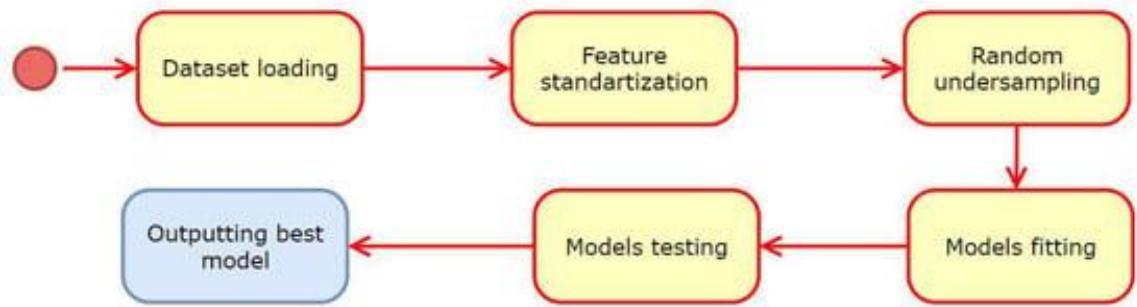
The process begins with dataset loading, where the authors utilize the Credit Card Fraud Detection dataset. Since most features are anonymized via Principal Component Analysis, the authors focus on standardizing the unencrypted time and amount variables. Standardization centers the variables around the mean with a unit standard deviation, expressed as:
X′=σX−μwhere μ is the mathematical expectation and σ is the standard deviation.
Following standardization, the authors apply random undersampling to the training set. This technique randomly removes examples from the majority class to balance the class distribution, ensuring the model does not become biased toward the dominant class.
Once the data is preprocessed, the authors proceed to model fitting. They evaluate a diverse set of candidate algorithms, including Random Forest, K-Nearest Neighbors, Logistic Regression, Stochastic Gradient Descent, Decision Tree, Naïve Bayes, and Support Vector Machine. For each model, hyperparameter tuning is performed using cross-validation to identify the optimal configuration.
To further enhance predictive accuracy, the authors explore stacked generalization. This method integrates multiple low-level models to improve a high-level meta-model. The authors generate K cross-sectional datasets from the original data to train K independent weak classifiers f1(⋅),…,fk(⋅). The results are then combined using a meta-model m:
res=m(f1(⋅)×f2(⋅)×⋯×fk(⋅))where the transformed features are combined with the training dataset to improve generalizability.
Finally, the pipeline concludes with model testing and outputting the best model. The authors evaluate the models using the Receiver Operating Characteristic curve and the Area Under the Curve metric. The curve plots the True Positive Rate against the False Positive Rate at varying classification thresholds. The True Positive Rate is defined as:
TPR=TP+FNTPand the False Positive Rate is defined as:
FPR=FP+TNFPwhere TP represents true positives, FN represents false negatives, FP represents false positives, and TN represents true negatives. The model achieving the highest metric on the testing data is selected as the final output.
Experiment
The study evaluated multiple classifiers on a highly imbalanced credit card fraud dataset, applying standardization and random undersampling for preprocessing. Among the individual models, logistic regression achieved the highest AUC of 0.946, but the ROC curves indicated that all algorithms performed similarly. A stacked generalization ensemble model further improved the results, reaching an F1 score of 0.96 and outperforming the single best classifier.