Command Palette
Search for a command to run...
Intern-S2-Preview: Scientific Agentic Foundation Model
Intern-S2-Preview: Scientific Agentic Foundation Model
Abstract
Scientific discovery increasingly requires AI systems that can reason over scientific evidence of heterogeneous modalities, interact with scientific tools and environments, and sustain progress across long task horizons. We present Intern-S2-Preview, a series of scientific agentic foundation models designed to support multimodal scientific understanding, reasoning, generation, and long-horizon tasks. The training pipeline begins with scientific multimodal pre-training over rendered scientific documents, interleaved image-text data, and diverse scientific corpora. Starting from the pretrained checkpoint, we apply a unified post-training pipeline consisting of supervised fine-tuning, scalable multi-task reinforcement learning (RL), blackand white-box agentic RL, and on-policy distillation. This pipeline is supported by practical techniques that improve rollout and training stability and eficiency, including partial rollout with of-policy correction, adaptive length regularization, online speculative decoding, robust multi-task optimization, and trace-aware experience assembly for agentic tasks. At the architecture level, Intern-S2-Preview-397B extends time series modelling from eficient long-sequence understanding to numerical forecasting, while Memory Decoder is studied as a separate memory-augmented path for rapid scientific specialization without modifying the frozen 397B backbone. Evaluations across scientific, multimodal, agentic, and general-purpose benchmarks show that Intern-S2-Preview-397B achieves competitive or leading results in multiple settings. The time series modules improve scientific signal understanding and forecasting on SciTS, while the separate Intern-MemDec-4B extension improves the Biology-Instructions average score from 56.92 to 60.32 without modifying the frozen 397B backbone.
One-sentence Summary
The Intern-S2-Preview Team at Shanghai AI Laboratory introduces Intern-S2-Preview, scientific agentic foundation models that combine multimodal pretraining over rendered scientific documents, interleaved image-text data, and diverse scientific corpora with supervised fine-tuning, multi-task reinforcement learning, black- and white-box agentic reinforcement learning, and on-policy distillation, using partial rollout with off-policy correction and adaptive length regularization for stable and efficient long-horizon tasks; Intern-S2-Preview-397B achieves competitive or leading results across scientific, multimodal, agentic, and general-purpose benchmarks, while Intern-MemDec-4B improves the Biology-Instructions average score from 56.92 to 60.32 without modifying the frozen 397B backbone.
Key Contributions
- The paper presents Intern-S2-Preview, a scientific agentic foundation model series trained through scientific multimodal pretraining over rendered documents, interleaved image-text data, and diverse scientific corpora, followed by a unified post-training pipeline combining supervised fine-tuning, scalable multi-task reinforcement learning, black-box and white-box agentic RL, and on-policy distillation.
- The work introduces post-training systems and optimization techniques for long-horizon and heterogeneous task mixtures, including partial rollout with off-policy correction, adaptive length regularization, online speculative decoding, Group-level Entropy-Controlled Policy Optimization, and trace-aware experience assembly. It also introduces a harness × task abstraction that decouples agent runtimes from executable task distributions.
- Intern-S2-Preview-397B achieves competitive or leading results on scientific, multimodal, agentic, and general-purpose benchmarks. The time series module improves scientific signal understanding and forecasting on SciTS, and the separate Intern-MemDec-4B memory-augmented extension raises the Biology-Instructions average score from 56.92 to 60.32 without modifying the frozen 397B backbone.
Introduction
Scientific AI is moving beyond text-based reasoning toward multimodal workflows that require sustained planning, tool use, and interaction with heterogeneous evidence over long horizons. Prior general-purpose LLMs offer broad instruction following but lack specialization for scientific modalities, domain protocols, and verifiable tool interaction, while scientific multimodal models are often evaluated as static question-answering systems rather than long-horizon agents. The authors address this gap with Intern-S2-Preview, a series of scientific agentic foundation models, focusing on Intern-S2-Preview-397B as the main evaluated system. The model adds a numerical forecasting branch to long-sequence time-series understanding and explores parametric memory modules attached to a frozen backbone for domain specialization without losing general-purpose capabilities. Its training pipeline combines scientific document and multimodal pretraining with multi-task reinforcement learning and an agentic RL framework to support iterative, tool-grounded scientific problem solving.
Dataset
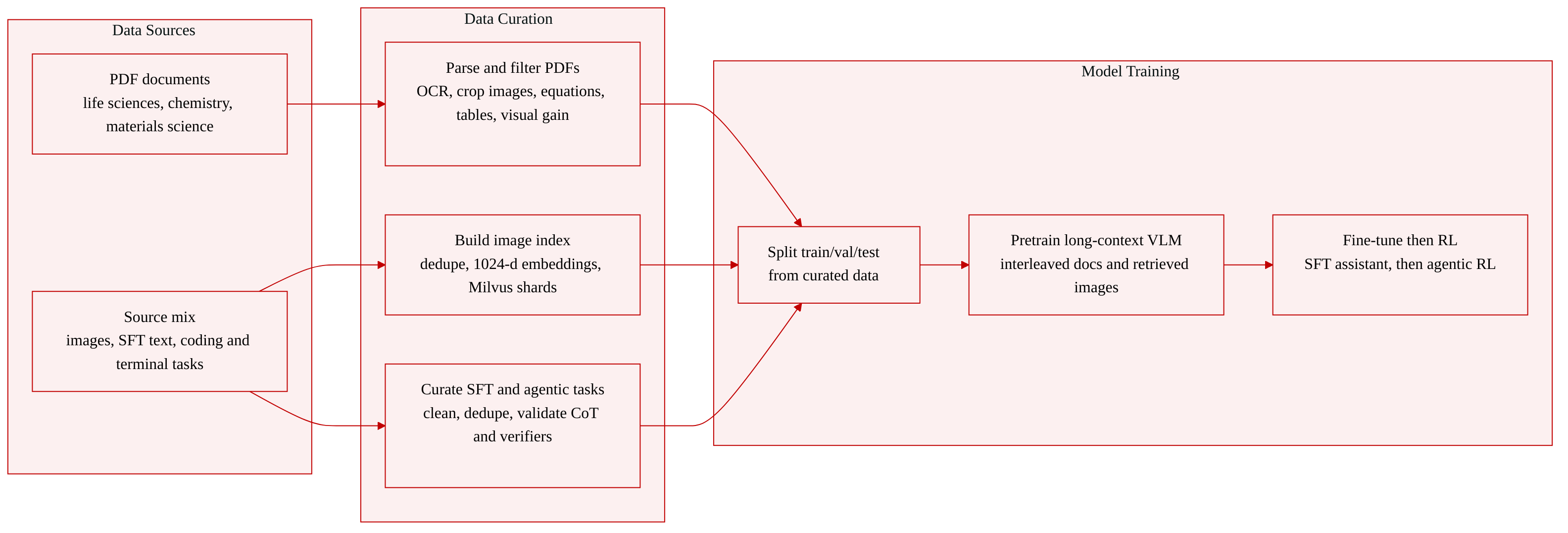
The authors use several dataset construction and processing pipelines:
-
Interleaved text-image pre-training data:
- Source: PDF documents focused on life sciences, chemistry, and materials science.
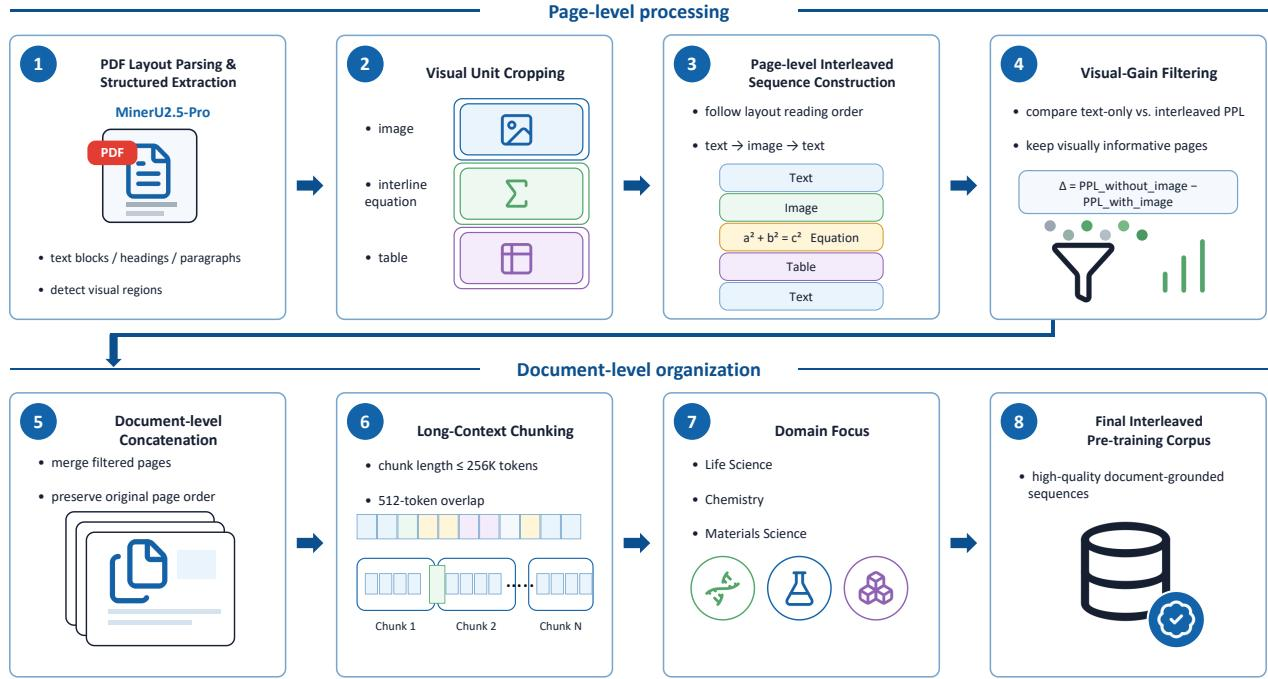
- Processing: MinerU2.5-Pro performs OCR and layout-aware structural parsing. Regular images, interline equations, and tables are cropped from PDF pages by bounding box coordinates and saved as standardized sub-images.
- Page-level sequences are built according to layout reading order and bounding-box order, using text blocks and visual units.
- Quality filtering: visual gain is computed as the language model perplexity difference between text-only and image/table/equation conditions. Pages are retained only when visual gain exceeds a domain-specific threshold and passes human review.
- Document chunking: filtered page sequences are concatenated in original PDF order and split into chunks capped at 256k tokens, with a 512-token overlap.
- Usage: long-context VLM pre-training, helping the model learn how visual units appear within document narratives and reasoning chains.
-
Image retrieval enhancement data:
- Source: delivered image data sources.
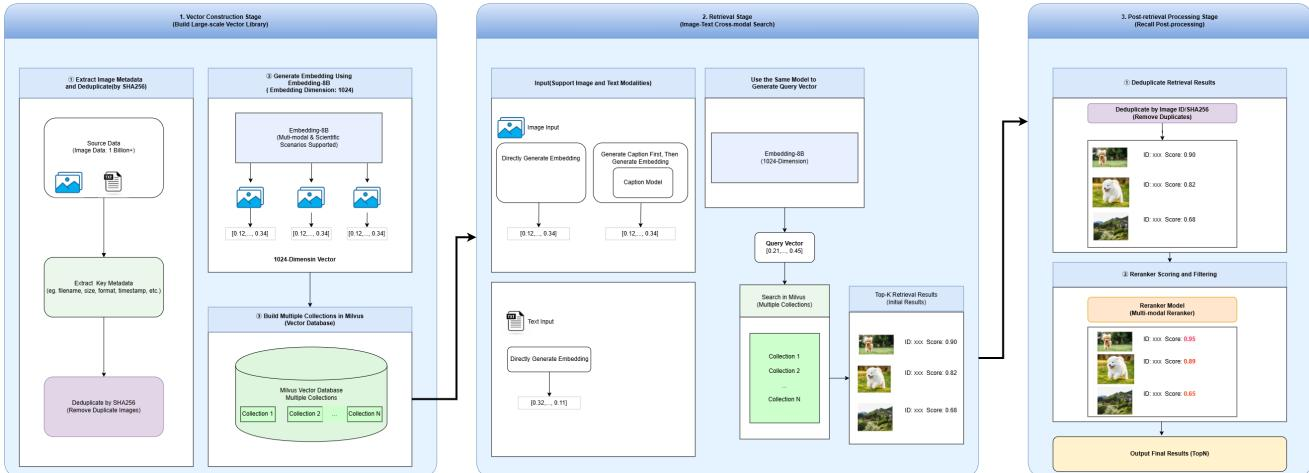
- Processing: images and key metadata are extracted, then deduplicated by SHA256 image values. An 8B embedding model encodes images into 1024-dimensional vectors, stored in sharded Milvus vector database collections.
- Retrieval supports text-to-image and image-to-image modes.
- For image input, the image is encoded directly and a caption model also generates text that is embedded, enabling joint visual and semantic retrieval. For text input, the text is embedded for cross-modal retrieval.
- Post-processing includes duplicate filtering, reranking with quality scores, and score-based final filtering.
- Usage: recall high-quality image data and raise its sampling ratio during training.
-
Supervised fine-tuning data:
- Composition: general conversation, instruction following, safety alignment, code generation and reasoning, image-text understanding, visual perception and spatial grounding, tool use, specialized scientific tasks, and long-horizon agentic trajectories.
- Processing: extensive filtering, cleaning, and deduplication. Chain-of-thought demonstrations are built through rejection sampling using Intern-S1-Pro and other leading open-source models, then validated by language models and human domain experts.
- Usage: the first post-training stage, converting the pretrained model into a controllable assistant before reinforcement learning.
-
Agentic task construction data:
- Source: public coding and terminal task collections plus a self-evolving synthesis system seeded with community-contributed skills.
- Common contract: each task includes an initialized execution environment, a natural-language objective, and an automatic verifier.
- Processing: public coding tasks are mapped by materializing repositories or containers, converting issue statements into objectives, and keeping tests or reward programs as verifiers. Self-evolving tasks are filtered for feasibility, safety, quality, and redundancy, then domain-balanced resampling is applied. A skill-state graph composes skills into varied-horizon capability paths. Each path is converted into environment, task, and verifier through a progressive pipeline with executable and semantic validators. Offline trajectories are outcome-filtered and step-level curated by behavior type; erroneous steps can be masked as skip.
- Usage: deployed in online agentic reinforcement learning and rolled out to construct reusable offline training data. Execution failures feed back to update skill sampling weights and synthesis prompts.
Method
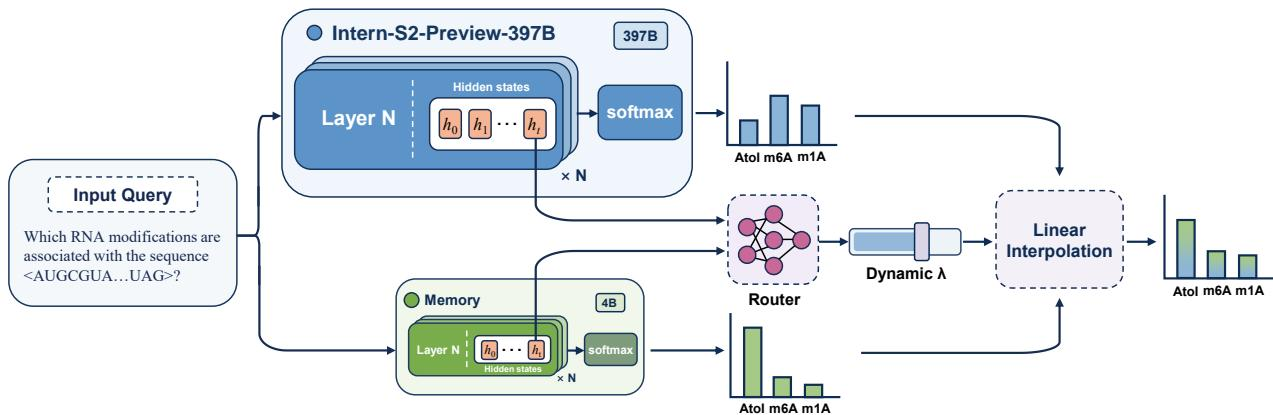
The authors extend the Intern-S2-Preview-397B model with specialized modules for time series modeling and a Memory Decoder for continual domain specialization. The Memory Decoder operates as a separate extension model that attaches external parametric memories to the frozen backbone. As shown in the figure below, at each decoding step, the frozen backbone and the memory decoder process the input in parallel to produce separate next-token distributions. A lightweight token-level router uses hidden states and uncertainty features to predict a dynamic fusion weight, controlling the contribution of each distribution to the final prediction. This design allows the model to integrate domain-specific knowledge without modifying the core parameters of the general-purpose backbone.
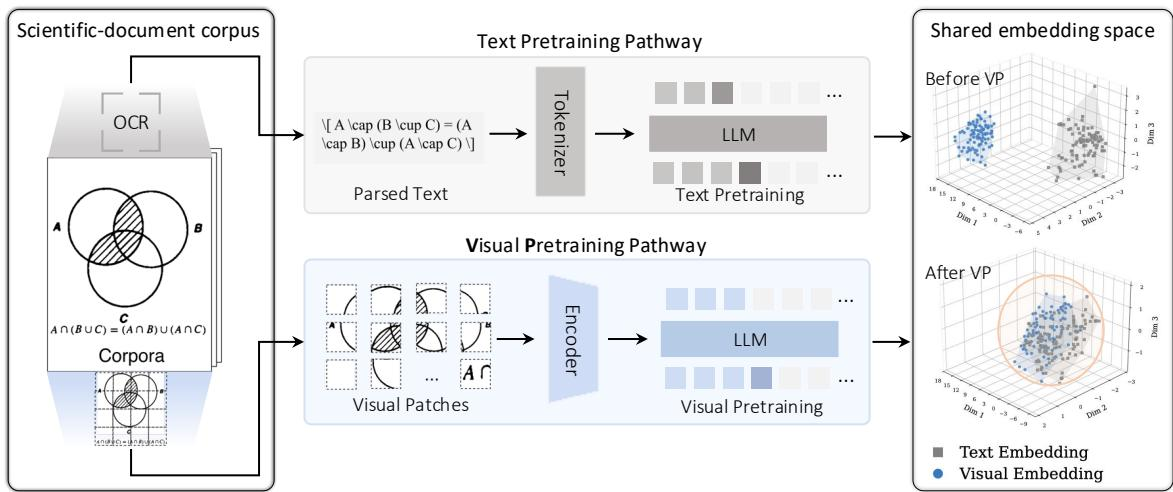
To strengthen the scientific data foundation, the authors introduce Visual Pre-training (VP) alongside conventional text pre-training. Refer to the framework diagram, the text pathway predicts tokens from parsed PDF content, while the visual pathway predicts foreground visual latents from rendered pages. This dual-pathway approach improves alignment between textual and visual document representations without requiring OCR or manual annotations.
To further enhance multimodal understanding, the authors construct interleaved image-text data from PDF documents. As shown in the figure below, the pipeline involves PDF layout parsing, visual unit cropping, and page-level interleaved sequence construction. A visual-gain-based quality filtering mechanism compares text-only versus interleaved perplexity to retain pages where visual content provides meaningful support. These sequences are then organized into document-level chunks for long-context pre-training.
Additionally, a large-scale image retrieval pipeline is introduced to recall high-quality data. Refer to the framework diagram, this process includes vector construction using an embedding model, online cross-modal retrieval, and post-processing with reranking and filtering to enhance the model's multimodal capabilities.
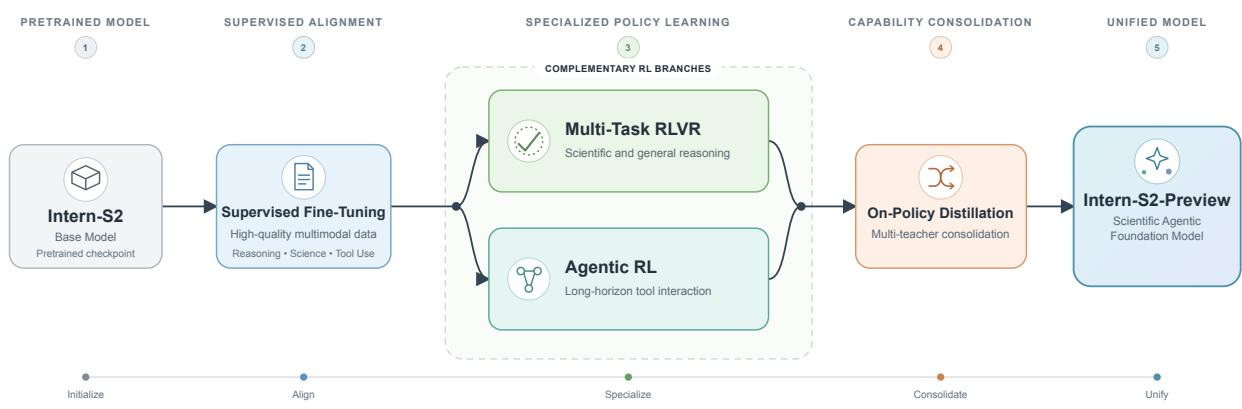
The post-training pipeline consolidates general and scientific capabilities through a multi-stage process. As illustrated in the figure below, starting from the pretrained checkpoint, the model undergoes supervised fine-tuning on high-quality multimodal data to establish fundamental reasoning and tool-use patterns. This is followed by specialized policy learning, where multi-task reinforcement learning improves scientific and general reasoning, while agentic RL cultivates long-horizon tool interaction capabilities. Finally, on-policy distillation merges the strengths of the reasoning and agentic policies into a single unified model.
Experiment
The experiments evaluate the Intern-S2-Preview-397B model across scientific and general-purpose benchmarks in both text-only and multimodal settings, while also examining post-training efficiency and architectural extensions. Adaptive length regularization reduces output length without sacrificing reward performance by reweighting positive responses only after the model has largely mastered a query. Main results show the model achieves leading open-source performance on many scientific and general benchmarks and strong agentic capabilities. Architecture studies indicate that the memory decoder improves targeted biology performance without hurting cross-domain behavior, and that dedicated time series modules improve both time series understanding and forecasting over general text and vision-language models.
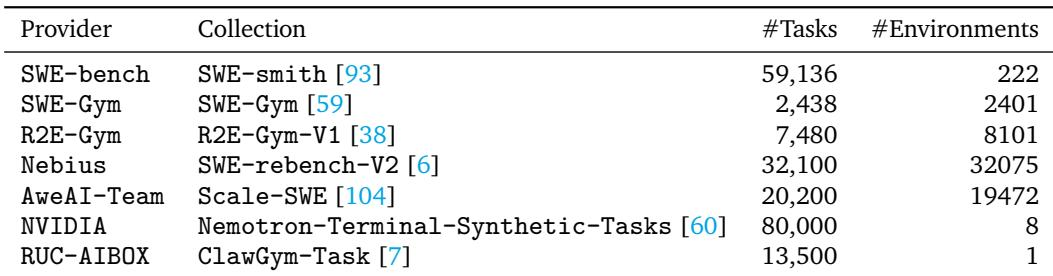
Seven public collections supply executable coding and terminal tasks, with task counts ranging from roughly two thousand to eighty thousand. Environment counts vary from one shared environment to over thirty-two thousand, reflecting different reuse strategies. Some collections concentrate many synthetic tasks in few environments, while others distribute tasks across many distinct environments. The NVIDIA Nemotron-Terminal-Synthetic-Tasks collection has the largest task count at 80,000 tasks but uses only eight environments. Nebius SWE-rebench-V2 provides the most environments, with around 32,000 tasks and a near equal number of environments. RUC-AIBOX ClawGym-Task is an extreme reuse case, mapping 13,500 tasks to a single environment.
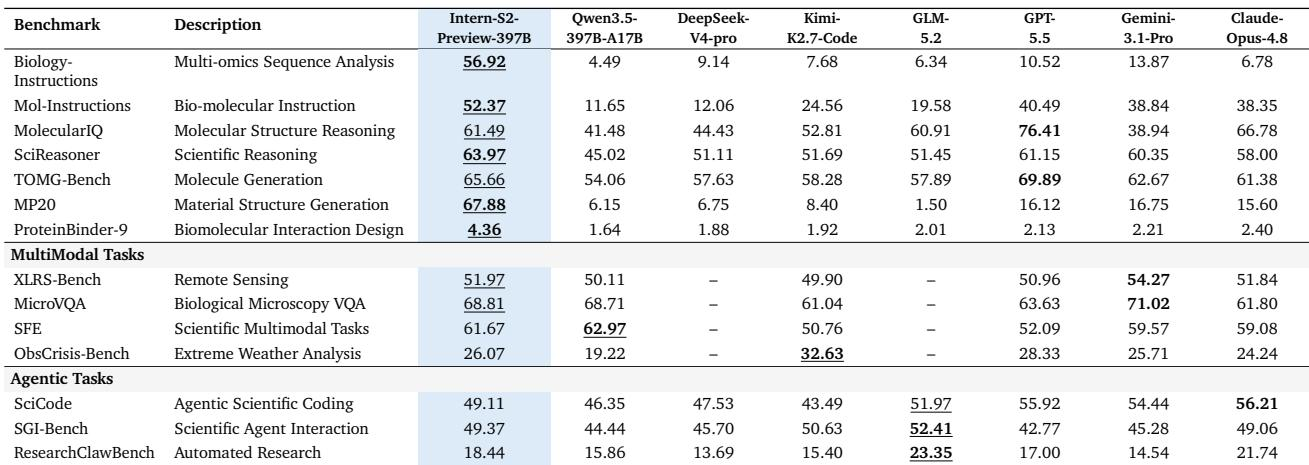
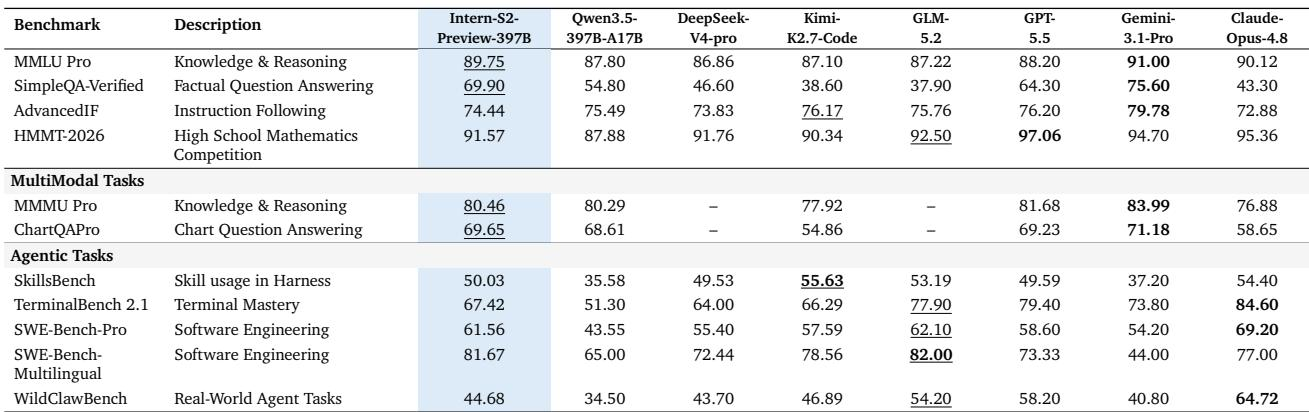
Intern-S2-Preview-397B leads the compared models on several scientific benchmarks, including biology instruction following, biomolecular instruction tasks, scientific reasoning, material structure generation, and biomolecular interaction design. It also achieves the strongest open-source results across multiple molecular, multimodal, and general-purpose benchmarks and ranks second only to GLM-5.2 on science-oriented agentic tasks. Intern-S2-Preview-397B records the best overall performance among all compared models on Biology-Instructions, Mol-Instructions, SciReasoner, MP20, and ProteinBinder-9. It is the strongest open-source model on MolecularIQ, TOMG-Bench, XLRS-Bench, MicroVQA, MMLU-Pro, SimpleQA-Verified, MMMU-Pro, and ChartQAPro.
Intern-S2-Preview-397B performs strongly on general benchmarks, achieving the best open-source results on MMLU-Pro, SimpleQA-Verified, MMMU-Pro, and ChartQAPro. Its standing is more mixed on AdvancedIF and HMMT-2026, where other models lead. Intern-S2-Preview-397B is the leading open-source model on MMLU-Pro, SimpleQA-Verified, MMMU-Pro, and ChartQAPro. On SimpleQA-Verified and ChartQAPro, Intern-S2-Preview-397B ranks second only to Gemini-3.1-Pro, while it is not the top open-source model on AdvancedIF or HMMT-2026.
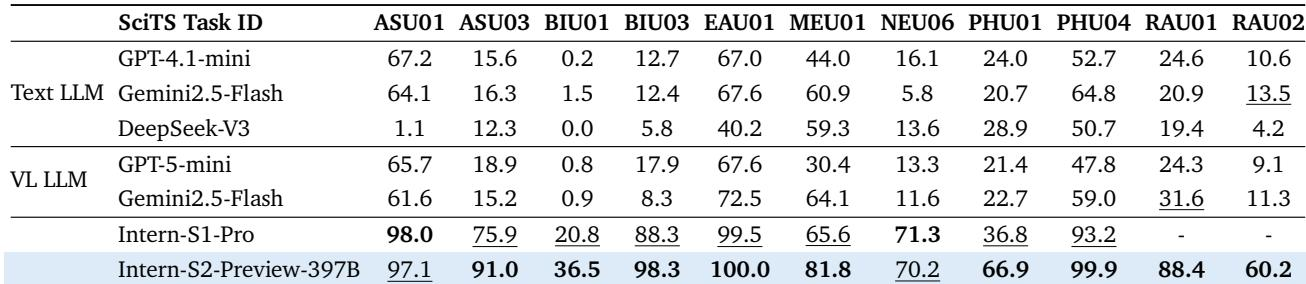
Intern-S2-Preview-397B consistently outperforms the evaluated general-purpose text LLMs and vision-language LLMs on SciTS time series understanding tasks, often by large margins. It also surpasses Intern-S1-Pro on seven of nine shared tasks despite using less than half the parameters, with especially large gains on ASU03, BIU03, MEU01, and PHU01. The model further extends coverage to radar coding-scheme classification and mode-and-modulation classification, where it achieves substantially higher F1 than the baseline models. Intern-S2-Preview-397B outperforms all listed general-purpose text and vision-language models on every SciTS time series understanding task, often by a wide margin. It surpasses Intern-S1-Pro on seven of nine shared tasks while using less than half the parameters, and it adds strong performance on two radar-related tasks that Intern-S1-Pro did not support.
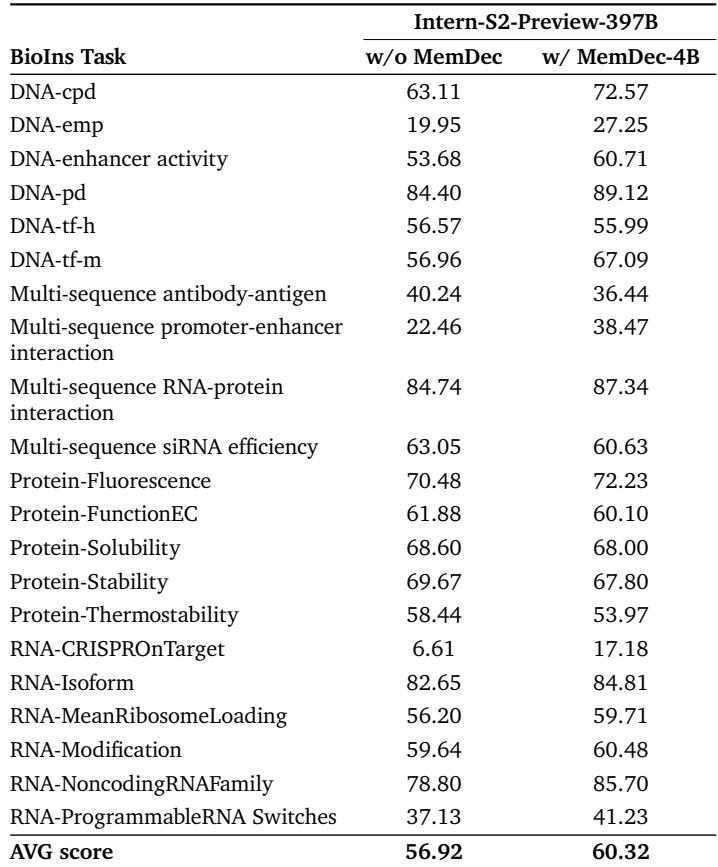
Adding the memory decoder to the frozen Intern-S2-Preview-397B backbone improves the Biology-Instructions average from 56.92 to 60.32. Most reported DNA-focused tasks gain, especially DNA-cpd and DNA-tf-m, while DNA-tf-h shows a small decline. The memory-augmented model remains close to the backbone on cross-domain benchmarks, suggesting targeted biological specialization rather than broad behavior change. The memory-augmented variant raises the Biology-Instructions average score from 56.92 to 60.32. Most listed DNA tasks improve, with DNA-cpd and DNA-tf-m showing especially large gains. DNA-tf-h is a slight exception, with a small decrease relative to the frozen backbone. Cross-domain performance remains close to the frozen backbone while target biology performance improves.
The experiments cover large-scale coding and terminal task collections with widely varying environment reuse, alongside benchmark evaluations of Intern-S2-Preview-397B across scientific, general-purpose, and time-series understanding tasks. Intern-S2-Preview-397B achieves leading open-source results on several scientific and general benchmarks and consistently outperforms baselines on time-series tasks. A memory decoder added to the frozen backbone improves biological instruction performance, especially on DNA-related tasks, while keeping cross-domain behavior close to the original model.