Command Palette
Search for a command to run...
Automatic Labeling of Semantic Roles
Automatic Labeling of Semantic Roles
Daniel Gildea
Abstract
We present a system for identifying the semantic relationships, or semantic roles, filled by constituents of a sentence within a semantic frame. Various lexical and syntactic features are derived from parse trees and used to derive statistical classifiers from hand-annotated training data.
One-sentence Summary
Researchers at UC Berkeley and the International Computer Science Institute present a statistical system that automatically labels semantic roles by deriving lexical and syntactic features from parse trees to train classifiers on hand-annotated data.
Key Contributions
-
A statistical system is introduced for identifying semantic roles by assigning frame elements to sentence constituents, using lexical and syntactic features extracted from parse trees and classifiers trained on hand-annotated data.
-
The approach defines roles at the semantic-frame level rather than through universal thematic roles, and identifies lexical head-word statistics as the most useful feature type, with feature combination needed to address data sparsity.
-
Experiments on a preliminary FrameNet corpus of 67 frames, 1,462 target predicates, 49,013 annotated sentences, and 99,232 frame-element labels show fairly high accuracy and that the combined feature model outperforms any single feature class.
Introduction
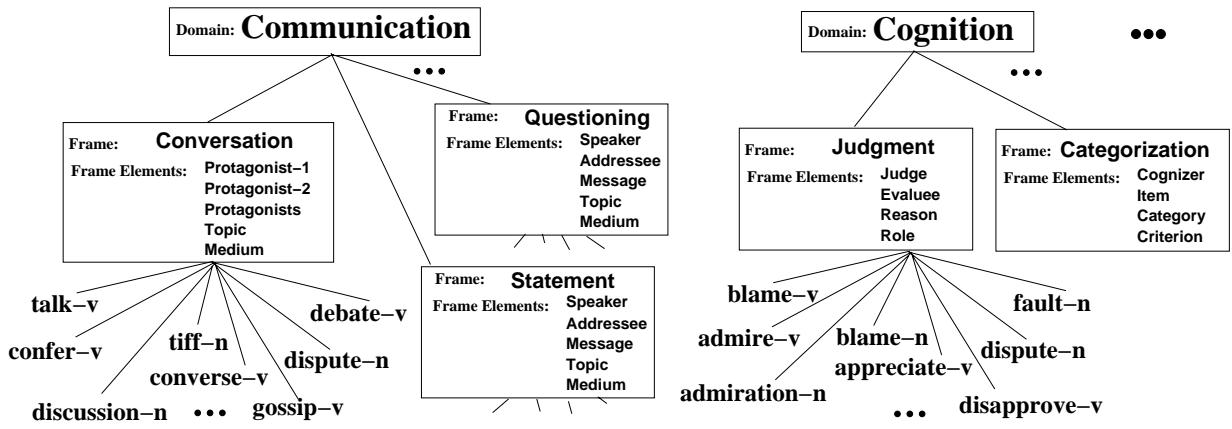
Semantic role labeling assigns participants such as AGENT, VEHICLE, or TOPIC to sentence constituents, providing a shallow semantic layer useful for information extraction, word sense disambiguation, machine translation, text summarization, and broader language modeling. In this setting, semantic roles are modeled through frames, which group related predicates and share role inventories, as in the conversation frame invoked by verbs such as “argue,” “debate,” and “gossip.” Prior systems often relied on hand-built grammars or narrow domain templates, making development costly and limiting coverage across general language. The authors address this by treating semantic role labeling as a statistical learning task, similar to parsing, part of speech tagging, and word sense disambiguation. They build a system trained on the FrameNet corpus, using FrameNet’s frame elements, lexical examples, and hand annotated sentences to automatically assign semantic roles to constituents.
Dataset
-
The authors use a preliminary version of the FrameNet corpus for experiments on frame-level semantic role annotation.
-
The data is organized around semantic frames rather than individual verb-specific roles. Frames represent schematic situations and link semantically related words, such as verbs and nouns that express conversation, argument, or discussion.
-
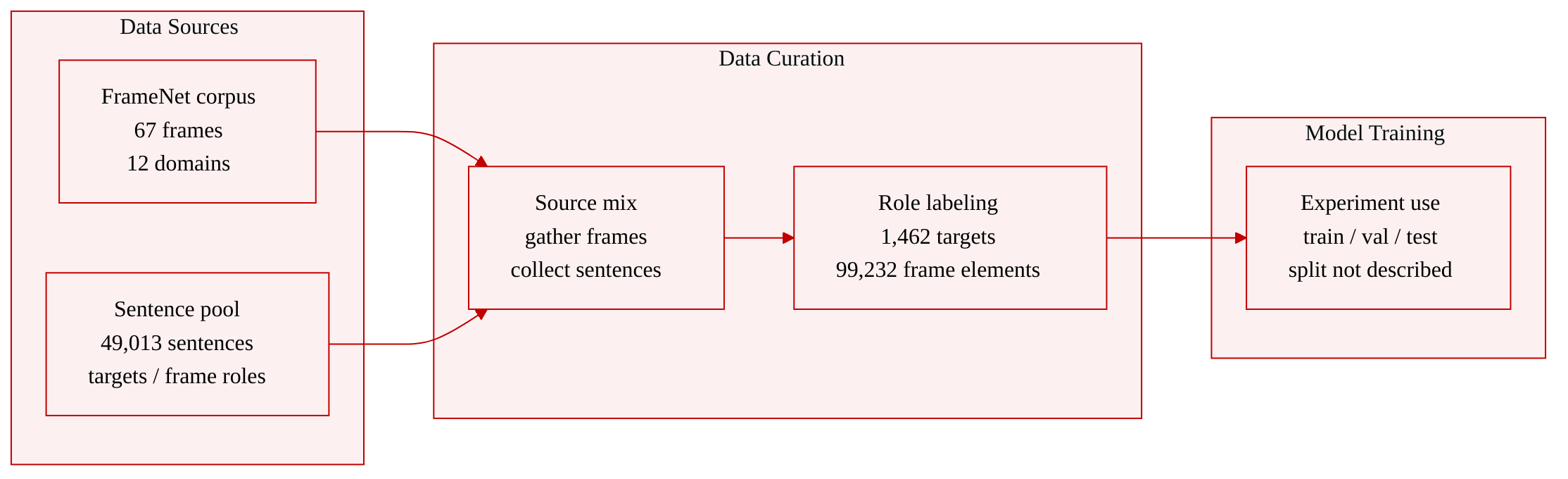
The corpus contains 67 frames selected from 12 general semantic domains. Example domains include motion, cognition, and communication.
-
Within these frames, 1,462 distinct lexical predicates are annotated as target words. These include 927 verbs, 339 nouns, and 175 adjectives.
-
The annotation includes 49,013 sentences. Each sentence is associated with target words and frame-level semantic roles.
-
The dataset contains 99,232 annotated frame elements. These frame elements exclude the target words themselves and are labeled with roles such as PROTAGONIST, MEDIUM, or TOPIC, depending on the frame.
-
The paper uses the data to represent semantic role annotation through intermediate frame-level roles, avoiding the need for a small set of fully universal abstract roles such as AGENT or PATIENT.
-
The provided text does not describe cropping, splitting into training and evaluation subsets, mixture ratios, or additional metadata construction beyond frame, target word, sentence, and frame element annotations.
Method
The authors decompose frame element labeling into two operations: determining constituent boundaries and assigning a semantic role to each extracted constituent. For role assignment, they use a statistical classifier trained from labeled data and applied to parsed sentences. The pipeline starts by running the Collins parser over the training sentences, matching annotated frame elements to parse constituents, and extracting linguistic features from the string and parse tree. During testing, the parser is applied to new sentences and the same features are generated. The reported role labeling component uses annotated boundaries, while boundary detection is handled as a separate concern. The alignment between parser output and semantic annotation is illustrated in the figure below.
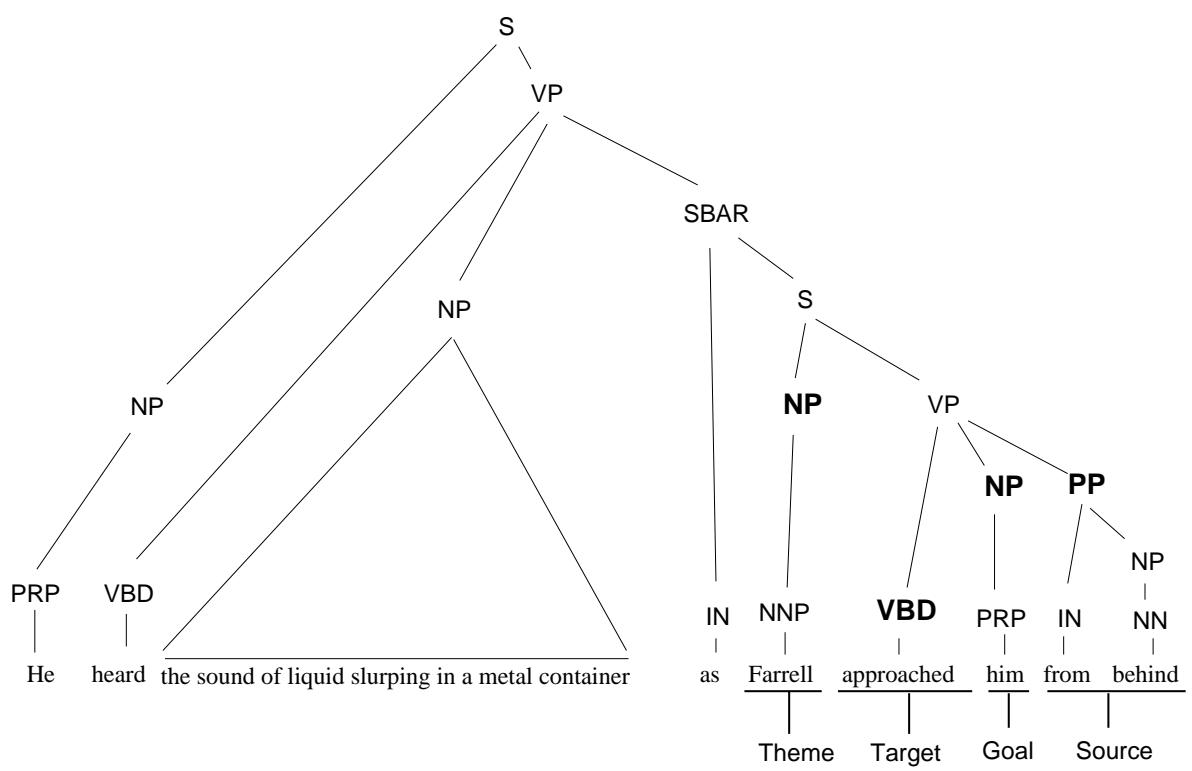
Several features are used to represent each candidate constituent. Phrase type is obtained from the syntactic category of the parse constituent that spans the frame element. If no constituent with exactly matching boundaries is found during testing, the largest constituent beginning at the left boundary and lying entirely within the candidate is used. Grammatical function is approximated for noun phrases by locating the nearest S or VP ancestor in the parse tree, where an S ancestor is treated as subject and a VP ancestor as object. Position records whether the candidate occurs before or after the target predicate. Voice is inferred by pattern matching over passive auxiliaries and past participles to distinguish active and passive predicates. Head word stores the lexical head of the constituent, since words such as pronouns or common nouns often signal particular semantic roles.
The training corpus is treated as the source of empirical statistics, but direct estimation over the full feature set is infeasible due to sparsity. Therefore, the authors build the classifier from multiple empirical distributions over selected feature combinations and combine their probability estimates. For a semantic role r and a conditioning feature set F, the basic estimator is
P(r∣F)=count(F)count(r,F)where count(r,F) is the number of training instances with role r and feature combination F, and count(F) is the total number of instances containing that conditioning event. At inference time, the system parses each sentence, generates the corresponding feature representations, evaluates the available empirical distributions, and assigns the role with the highest combined probability to each candidate frame element.
Experiment
The experiments evaluate a statistical semantic role labeling system trained on FrameNet and tested by extracting features from parse trees and target word identities. They compare and ablate combinations of syntactic and lexical evidence, showing that both syntactic relations such as subjecthood or position and head word information are essential, while clustering head words improves coverage for sparse lexical cases. A further experiment validates automatic frame element boundary identification and finds that role labeling remains robust when using automatically detected constituents.
The examples illustrate how semantic roles in the conversation frame are expressed with related target words such as argue and argument. The same role set applies across both verb and noun uses, covering participants, topic, and medium. This supports defining semantic roles at the level of a shared frame rather than for each target word separately. Protagonist roles appear in both verb and noun examples, including a combined Protagonists role. Topic and Medium roles are shown in parallel for both target word forms. Semantically related words can share the same frame-level roles.

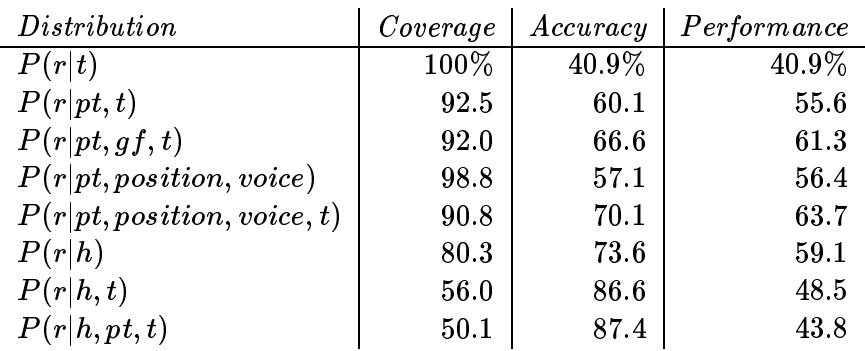
The distributions show that using only the target word gives complete coverage but low accuracy, while adding phrase type, grammatical function, position, and voice improves performance when sufficient coverage is available. Head word based features are accurate when applicable, but the target word and head word combination has much lower coverage, reducing its overall usefulness. The strongest overall results come from models that combine syntax related features with target word information while retaining broad coverage. Target word alone is fully coverable but gives the weakest overall performance. Phrase type, grammatical function, and position related features improve role identification accuracy. Head word with target word has high accuracy but limited coverage, limiting overall performance.
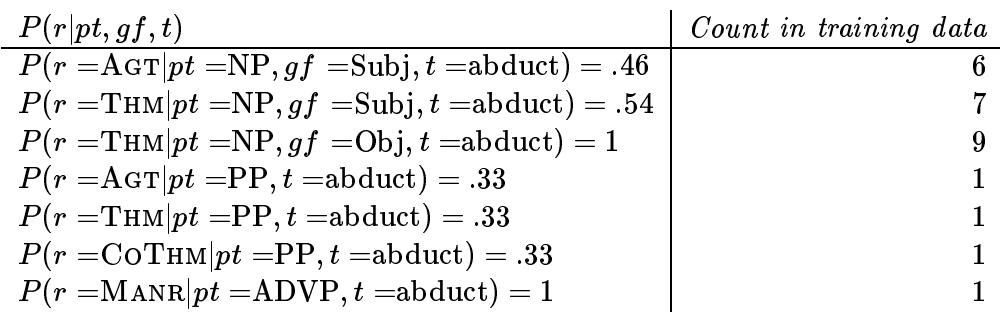
The training data show role cues for abduct depend strongly on phrase type and grammatical function. Noun phrases with subject function are split between AGENT and THEME, while noun phrases with object function appear consistently as THEME. Prepositional and adverbial phrases offer weaker or sparser cues, with adverbials indicating MANNER. Subject noun phrases for abduct are ambiguous between AGENT and THEME. Object noun phrases for abduct are strongly associated with THEME. Grammatical function cues apply only to noun phrases, so non-noun phrases rely mainly on phrase type.
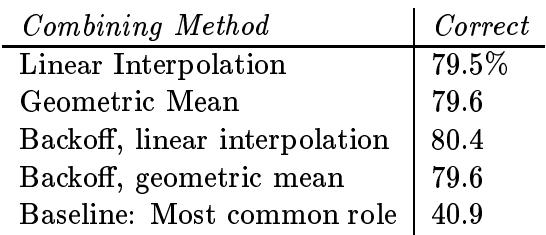
On the development set, different ways of combining probability distributions give very similar role-labeling accuracy. Backoff-based linear interpolation performs slightly better than the other combination strategies, while geometric mean combinations remain close to simple linear interpolation. All of these methods are much better than the most common role baseline. Backoff linear interpolation is the strongest combination method in the reported results. Geometric mean combinations are comparable to simple linear interpolation. All probability-combination methods substantially outperform the most common role baseline.
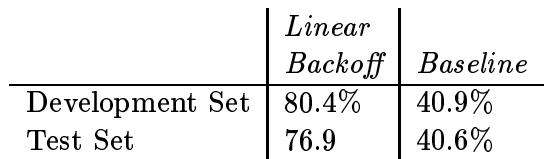
The backoff linear interpolation system gives a test-set result below the baseline development performance, indicating some drop when moving from development to test data. The other reported score remains very close between development and test, suggesting that the two measures behave differently under the larger 7900-observation test set. Test-set performance is lower than the 80.4% development-set baseline. The percentage-based score stays nearly unchanged from development to test.
The experiments evaluate semantic role identification for conversation-related predicates, showing that related verb and noun forms can share frame-level roles for participants, topic, and medium. Feature analysis indicates that target-word information provides broad coverage but limited accuracy, while syntactic and head-word features improve performance when applicable, with combined syntax-target models offering the best overall balance. Further analysis reveals that role cues depend on phrase type and grammatical function, and different probability-combination methods yield similar gains over a common-role baseline, although some systems show reduced stability from development to test sets.