Command Palette
Search for a command to run...
SPZ: A Semantic Perturbation-based Data Augmentation Method with Zonal-Mixing for Alzheimer's Disease Detection
SPZ: A Semantic Perturbation-based Data Augmentation Method with Zonal-Mixing for Alzheimer's Disease Detection
Fangfang Li Cheng Huang Puzhen Su Jie Yin
Abstract
Alzheimer's Disease (AD), characterized by significant cognitive and functional impairment, necessitates the development of early detection techniques. Traditional diagnostic practices, such as cognitive assessments and biomarker analysis, are often invasive and costly. Deep learning-based approaches for non-invasive AD detection have been explored in recent studies, but the lack of accessible data hinders further improvements in detection performance. To address these challenges, we propose a novel semantic perturbation-based data augmentation method that essentially differs from existing techniques, which primarily rely on explicit data engineering. Our approach generates controlled semantic perturbations to enhance textual representations, aiding the model in identifying AD-specific linguistic patterns, particularly in scenarios with limited data availability. It learns contextual information and dynamically adjusts the perturbation degree for different linguistic features. This enhances the model's sensitivity to AD-specific linguistic features and its robustness against natural language noise. Experimental results on the ADReSS challenge dataset demonstrate that our approach outperforms other strong and competitive deep learning methods.
One-sentence Summary
Central South University, Xiangjiang Laboratory, and University of Sydney propose SPZ, a semantic perturbation-based data augmentation method with zonal-mixing that generates controlled perturbations to enhance textual representations and dynamically adjusts perturbation degrees per linguistic feature, enabling more robust non-invasive Alzheimer's disease detection under limited-data conditions.
Key Contributions
- SPZ is introduced as a semantic perturbation-based data augmentation framework for non-invasive Alzheimer's disease detection in data-limited settings, applying controlled perturbations to existing transcripts without manual data engineering.
- SPZ combines a Generator that produces token-level perturbations from Gaussian or skewed distributions using a temperature-dependent Gumbel-Softmax trick with a Mediator that assigns word-specific perturbation probabilities, then mixes initial representations and noise through zonal-mixing to refine textual representations while preserving original semantics and highlighting AD-specific linguistic patterns.
- Experiments on the ADReSS challenge dataset show that SPZ outperforms strong deep learning baselines, indicating that controlled semantic perturbations can improve AD detection accuracy and robustness.
Introduction
Alzheimer's disease detection benefits from automated speech and text analysis because AD patients often show distinctive language patterns, such as more filler words, fewer informative nouns and verbs, disorganized syntax, pauses, and hesitations. This matters because traditional cognitive tests and biomarker analysis are costly and time intensive, while language-based methods can support scalable early screening. Prior work is limited by small labeled datasets, privacy concerns, and data augmentation methods that use random deletions, substitutions, paraphrasing, or generation. These approaches can remove AD-specific cues, introduce augmentation bias, require manual data engineering, and reduce model generalization. The authors propose SPZ, a plug-and-play data augmentation framework that applies controlled semantic perturbations to existing transcripts instead of creating new samples. SPZ uses a Generator module to add temperature-controlled Gaussian noise and a Mediator module to assign word-level perturbation probabilities, then mixes representations to preserve original semantics while increasing sensitivity to AD-specific features. This improves AD detection in data-limited settings and achieves competitive performance on the ADReSS dataset.
Dataset
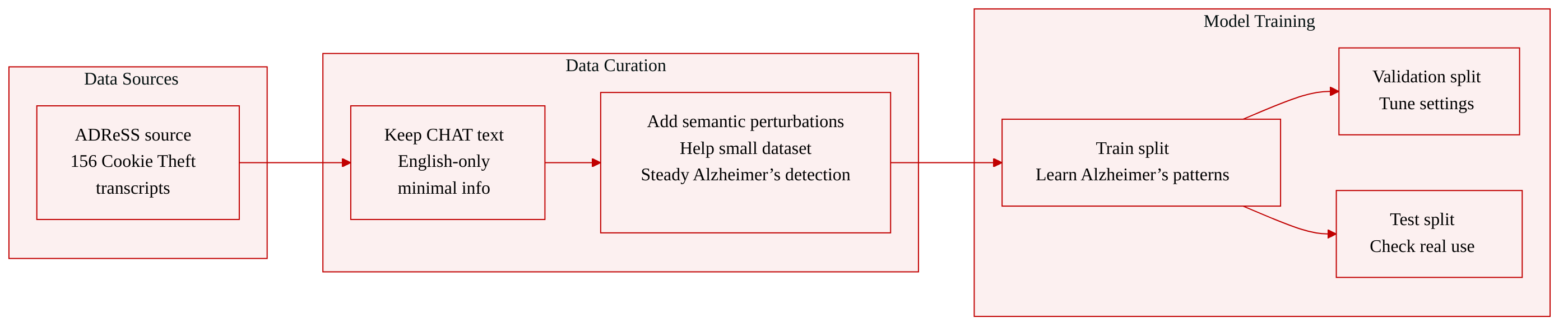
-
Source: The authors use the ADReSS Challenge Dataset, a standardized benchmark for Alzheimer’s disease detection. It contains 156 speech samples with corresponding transcripts from English speakers performing the Cookie Theft picture description task.
-
Composition: The dataset includes 78 non-AD participants and 78 AD-affected participants. Each group has 35 male and 43 female speakers, giving a balanced distribution across diagnostic status and gender. Age is also described as balanced, though exact age categories are not provided in the excerpt.
-
Modality and schema: The study focuses only on transcript data, not audio. Transcripts are formatted according to the CHAT protocol, a standard format for TalkBank data.
-
Metadata and labels: The dataset supports AD classification using participant diagnostic status, gender, and age-related metadata. The balanced design is intended to reduce potential bias in prediction tasks.
-
Dataset size and challenge: With 156 samples, the dataset is small, partly because of collection difficulty and privacy concerns. The authors treat this limited scale as a central challenge for building robust AD classification models.
-
Processing and augmentation: The authors construct their training setup around textual transcripts. They apply controlled semantic perturbations as a data augmentation strategy to improve textual representations and reliability in data-limited conditions. No split ratios or detailed training mixture are specified in the provided text.
-
Additional processing notes: The excerpt does not describe cropping, image preprocessing, or new metadata construction. The main processing step is using CHAT-formatted transcript text for AD detection.
-
Ethics and source context: The data comes from the ADReSS challenge and follows strict protocols for minimal personal information and access control. The English-only transcript data limits cultural representation, and the work is positioned for academic research rather than direct clinical deployment.
Method
The authors propose Semantic Perturbation with Zonal mixing, a lightweight data augmentation framework that improves representation learning for Alzheimer’s Disease transcript detection in data constrained settings. Rather than generating entirely new sentences, the method operates at the level of token embeddings and introduces controlled semantic perturbations to existing linguistic representations. The framework is intentionally simple, modular, and easy to optimize, while still encouraging the classifier to become more sensitive to AD related linguistic patterns.
The architecture can be understood as a BERT encoding backbone followed by three information pathways. As shown in the framework diagram below:
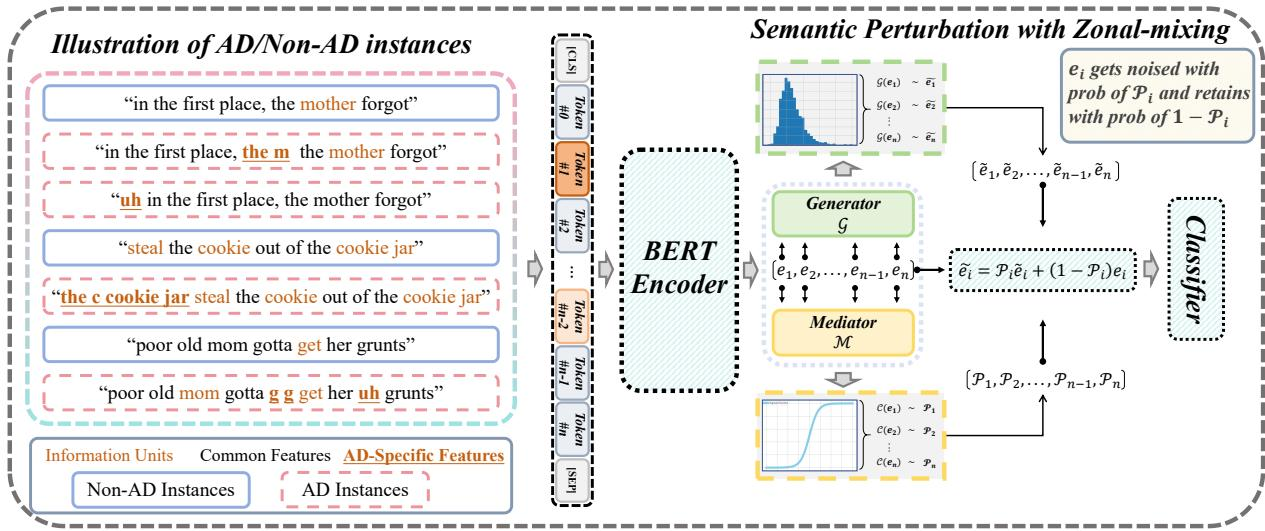
The first pathway embeds each transcript into token level representations, the second pathway generates semantic perturbations for those representations, the third pathway learns a per token perturbation degree, and the final pathway combines the original and perturbed states for classification.
For an input transcript T={t1,t2,⋯,tn}, the authors use a pretrained BERT encoder as the text encoder. Unlike approaches that classify only from the [CLS] token, this method uses the full token level output, excluding the special tokens [CLS] and [SEP]. The encoding process is:
E=BERT(T)This produces contextualized token representations E={e1,e2,⋯,en}, where each ek captures the semantic context of the corresponding word within the transcript. Using all token representations allows the model to retain fine grained information about common features, information units, and AD specific cues.
The core augmentation mechanism is introduced through two modules: a Generator and a Mediator.
The Generator is designed to produce perturbations that are more structured than random noise. For each token representation, the method first samples noise from a Gaussian distribution:
U~={u~1,u~2,…,u~n}∼N(0,σ2)Because Gaussian noise lacks a clear semantic direction, the method transforms it into Gumbel noise:
g=−log(−log(u~+ε)+ε)The perturbed token representations are then obtained through a low temperature softmax:
ei′=∑j=1nexp{(ej+gj)/τ}exp{(ei+gi)/τ}where τ controls the smoothness of the distribution. With a lower temperature, such as τ=0.2, the perturbations become more extreme and targeted, which helps expose specific linguistic elements that may be relevant for AD detection.
The Mediator controls how much each token should deviate from its original state. It computes a continuous perturbation degree from the original contextual representation:
pi=1+exp{−(wi⋅ei+b)}1Here, pi is a trainable scalar in (0,1) that determines the strength of the perturbation applied to token i. The sigmoid activation provides a smooth transition between the original and perturbed states, enabling stable training.
The original and perturbed representations are then integrated through a zonal mixing operation:
e~i=(1−pi)ei+piei′This yields the final augmented representation E~={e~1,e~2,⋯,e~n}. By learning the mixing ratio during training, the model can adaptively decide which tokens should remain close to their original form and which should receive stronger semantic perturbation. This preserves the integrity of most transcript content while selectively encouraging sensitivity to potentially informative AD related patterns.
The final classifier operates on the mixed representations. A global max pooling layer first aggregates token level information into a fixed length vector, followed by a sigmoid classification layer:
z=GlobalMaxPooling(E~) y^=Sigmoid(z)The output y^ represents the predicted probability of an Alzheimer’s Disease case. During training, the authors minimize the binary cross entropy loss:
LBCE=−i=1∑Nyilog(y^i)+(1−yi)log(1−y^i)where yi is the ground truth label. Through this end to end optimization, the BERT encoder, perturbation generator, mediator, and classifier are trained together to learn representations that are both robust and more discriminative for early stage AD detection.
Experiment
The experiments evaluate Alzheimer's disease detection using accuracy and AD-class precision, recall, and F1 under 10-fold cross-validation over multiple seeds, comparing the proposed SPZ model with representative single-model and ensemble baselines. The main comparison shows that SPZ benefits from semantic perturbation and token-level processing over standard discriminative models and augmentation-based approaches, while ablations indicate that both the Generator and Mediator contribute to stronger AD detection. Further Mediator analyses show that perturbation degrees are selectively controlled, preserving clinically meaningful AD-related language while applying higher perturbation to less informative features and assigning greater overall perturbation to non-AD cases.
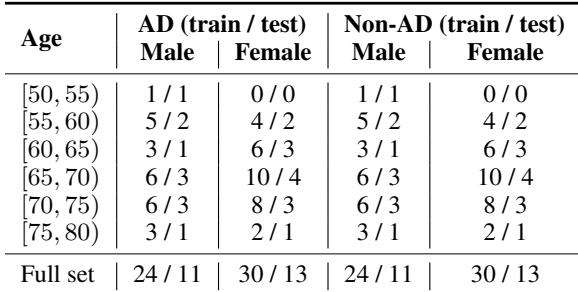
The provided dataset contains 156 Cookie Theft picture description samples from English speakers, divided into AD-affected and Non-AD groups. The age and gender statistics show the same AD and Non-AD counts within each male and female age bin, supporting balanced class representation and relatively even age coverage. The small dataset size is described as a challenge for robust AD classification and motivates data augmentation with controlled semantic perturbations. AD and Non-AD speakers are equally represented within each reported male and female age bin. Most speakers fall in the 65 to 75 age range, with fewer samples at the youngest and oldest ages.
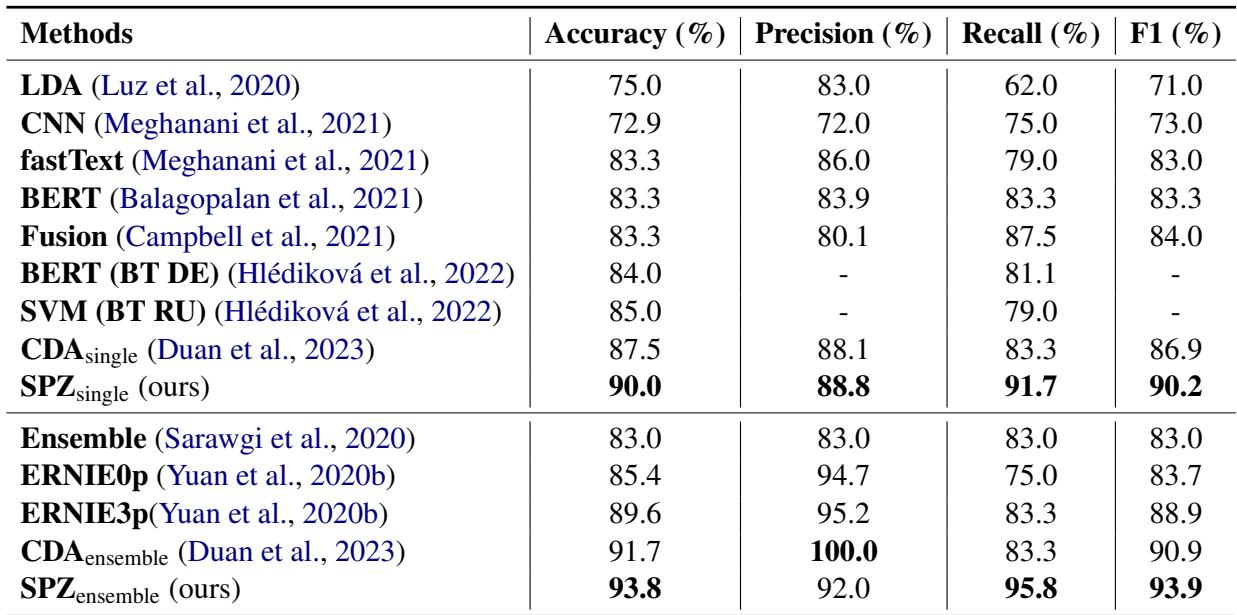
The proposed SPZ single model achieves the strongest overall performance among the compared AD detection methods, with the highest accuracy, precision, recall, and F1 score. Compared approaches vary widely, with conventional baselines showing weaker or uneven results, while data augmentation improves some model families. The results support SPZ as an effective method for this challenge dataset. SPZ single outperforms the listed baselines and existing ensemble or augmented methods across all reported metrics. Data augmentation improves selected models, but the augmented methods remain below SPZ single in overall effectiveness. fastText shows a strong recall gain, while BERT and related approaches provide higher accuracy than the baseline models.
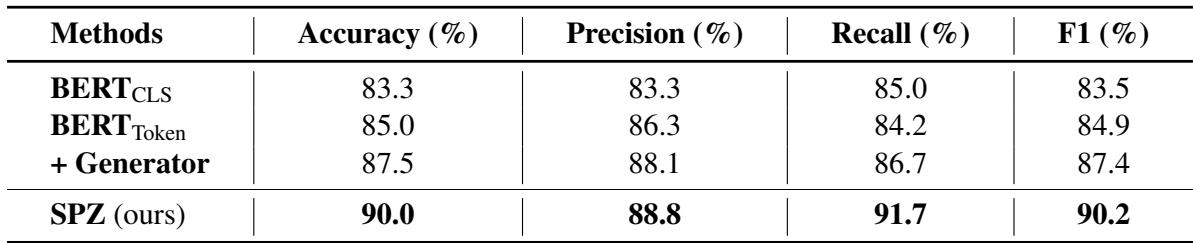
The ablation shows that token-level embeddings improve most metrics over the CLS token baseline, indicating that fine-grained representations help the model. Adding the Generator module further improves performance, and the full SPZ model with the Mediator achieves the best overall results, especially in recall. Token-level embeddings outperform the CLS token baseline on accuracy, precision, and F1, with a slight drop in recall. The Generator module gives clear gains over token-level BERT, particularly in precision and F1. The full SPZ model achieves the strongest reported overall performance and the highest recall.
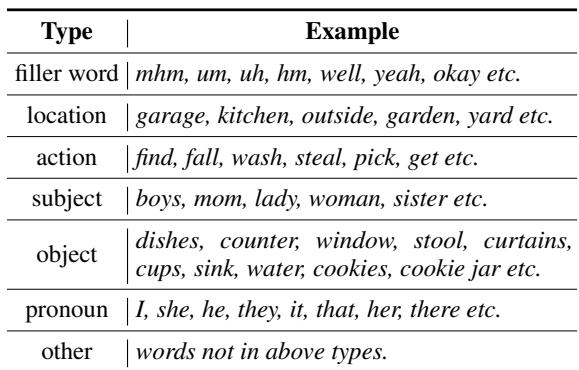
The table defines seven transcript word types used to analyze how the Mediator module perturbs language. It separates clinically important content, such as object, location, and action words, from less distinctive forms, such as filler words, pronouns, subjects, and other words. The surrounding analysis indicates that clinically meaningful words are retained more strongly, especially in AD instances. Object, location, and action words are treated as clinically important transcript features. Filler words, pronouns, subjects, and other words serve as less distinctive comparison categories. The word type grouping supports analysis of perturbation differences between AD and non AD instances.
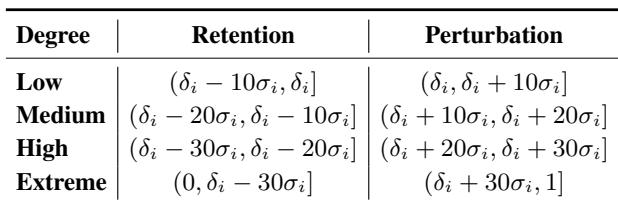
The table defines perturbation degree categories from sentence-level mean and variance, separating words into low, medium, high, and extreme retention or perturbation ranges. The surrounding analysis indicates that the mediator module applies lower perturbation to clinically important AD-related features while using higher and more variable perturbation for non-AD or less relevant features. Perturbation categories are based on each sentence's average perturbation degree and variance. Clinically important features are retained with lower perturbation. Non-AD instances receive higher and broader perturbation than AD instances.
The experiments use 156 balanced Cookie Theft picture-description samples to compare AD detection methods, ablate model components, and inspect semantic perturbations. The proposed SPZ single model is qualitatively most effective overall, while augmentation benefits some baselines, token-level embeddings, the Generator, and the Mediator each contribute to stronger classification with the full model showing particularly strong recall. The perturbation analysis indicates that the Mediator preserves clinically important AD-related content more strongly and applies higher, more variable changes to less relevant or non-AD features, supporting the model’s clinical validity.