Command Palette
Search for a command to run...
Sage-Taiyi: A Metacognitive Architecture for Scientific Discovery
Sage-Taiyi: A Metacognitive Architecture for Scientific Discovery
Abstract
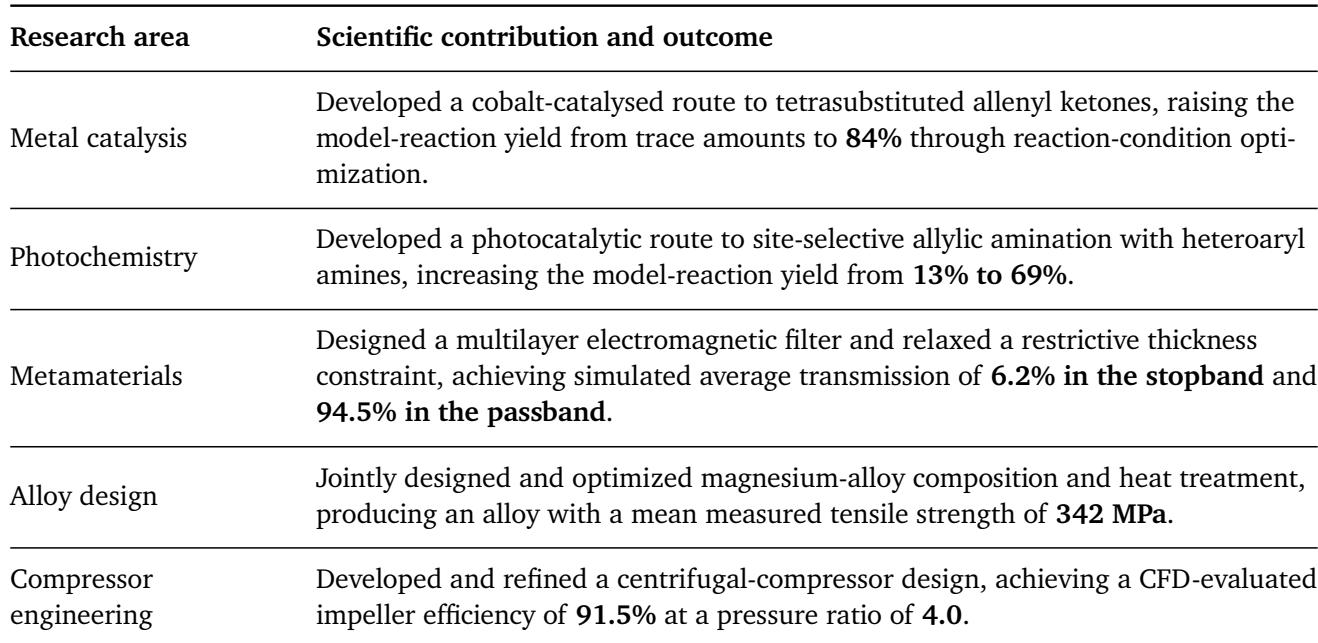
We introduce Sage-Taiyi, a metacognition-inspired architecture that uses accumulated scientific understanding to guide what to investigate next and how to investigate it. Through explicit monitoring and control, the system revises its understanding of evidence, assumptions, and unresolved questions, then uses these assessments to adapt research targets and select reusable reasoning methods. On Taiyi-Bench, an AI co-scientist ideation benchmark comprising 265 tasks from 50 papers across ten disciplines, Sage-Taiyi ranks first on all eight metrics of historical rediscovery and open-ended ideation, achieving an Overall score of 54.0 compared with 47.9 for the strongest baseline, AI Scientist-v2. It also performs well on two external scientific ideation benchmarks. Five expert-guided collaborations further connect its proposals to experimental and computational validation across chemistry, materials science, and engineering. In chemistry, reaction-condition optimization raises the yield of cobalt-catalyzed carbonylation from trace amounts to 84% and photocatalytic allylic amination from 13% to 69%. These results support metacognitive regulation as an approach to scientific ideation and its progression toward practical validation.
One-sentence Summary
Researchers at the Shanghai Artificial Intelligence Laboratory introduce Sage-Taiyi, a metacognition-inspired architecture that revises evidence, assumptions, and questions to adapt research targets and reasoning methods, ranking first on all eight Taiyi-Bench ideation metrics with an Overall score of 54.0 versus 47.9 for AI Scientist-v2 and raising carbonylation yield from trace amounts to 84%.
Key Contributions
- Sage-Taiyi is introduced as a metacognition-inspired architecture that uses accumulated scientific understanding to guide what to investigate next and how to investigate it, through explicit monitoring and control, a revisable Cognitive State, and a reusable Cognitive Repertoire.
- On Taiyi-Bench, a 265-task ideation benchmark from 50 papers across ten disciplines, Sage-Taiyi ranks first on all eight metrics, achieving an Overall score of 54.0 compared with 47.9 for the strongest baseline, AI Scientist-v2, and also performs well on two external scientific ideation benchmarks.
- Five expert-guided collaborations connect Sage-Taiyi's proposals and search formulations to experimental and computational validation across chemistry, materials science, and engineering, with reaction-condition optimization raising cobalt-catalyzed carbonylation yield from trace amounts to 84% and photocatalytic allylic amination from 13% to 69%.
Introduction
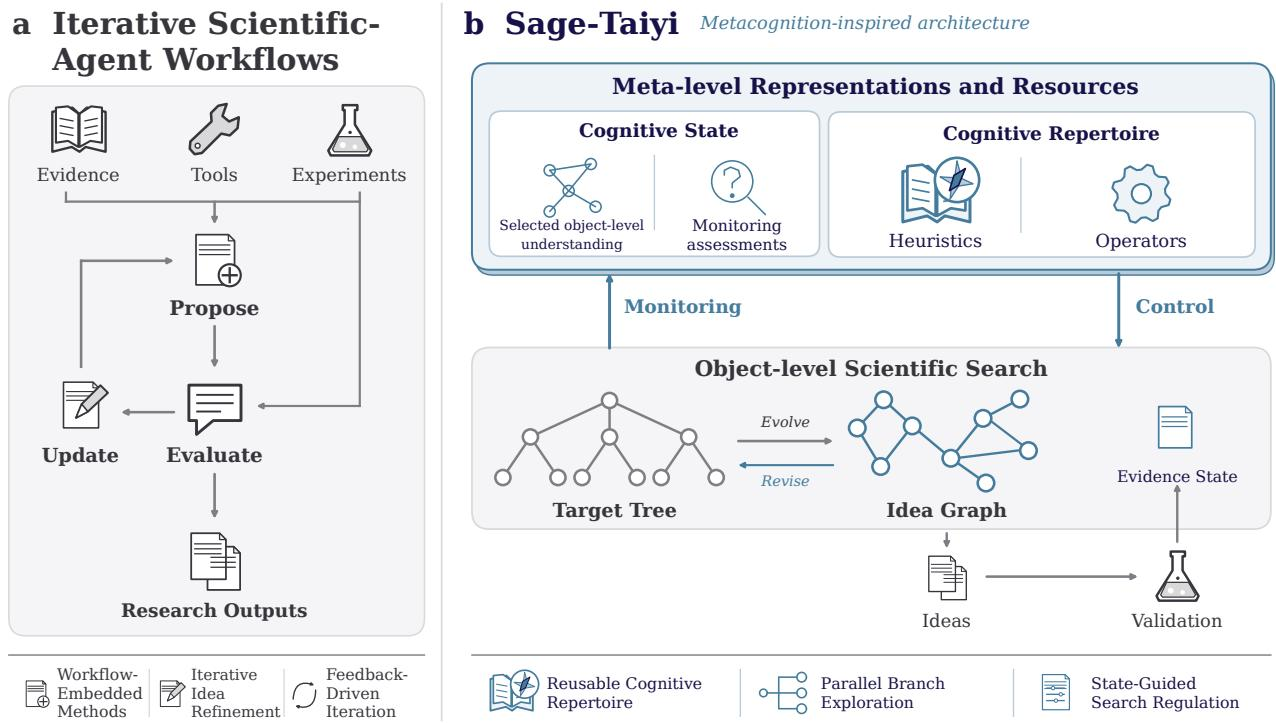
Modern AI research agents extend one-shot idea generation into iterative scientific workflows, but simple iteration often fails to retain findings with their supporting evidence and applicability conditions. When search depends mainly on the current round of feedback, earlier failures and unresolved conflicts can be overlooked, leading to repeated errors or unproductive paths. The authors address this by drawing on metacognition, treating scientific search as an object-level process that needs an explicit meta-level monitor and controller. They introduce Sage-Taiyi, a metacognition-inspired architecture that uses a revisable Cognitive State and a reusable Cognitive Repertoire to guide what to investigate next and how to investigate it. Sage-Taiyi ranks first on all eight Taiyi-Bench metrics, and expert collaborations show its proposals transitioning toward practical validation in chemistry, materials science, and engineering.
Method
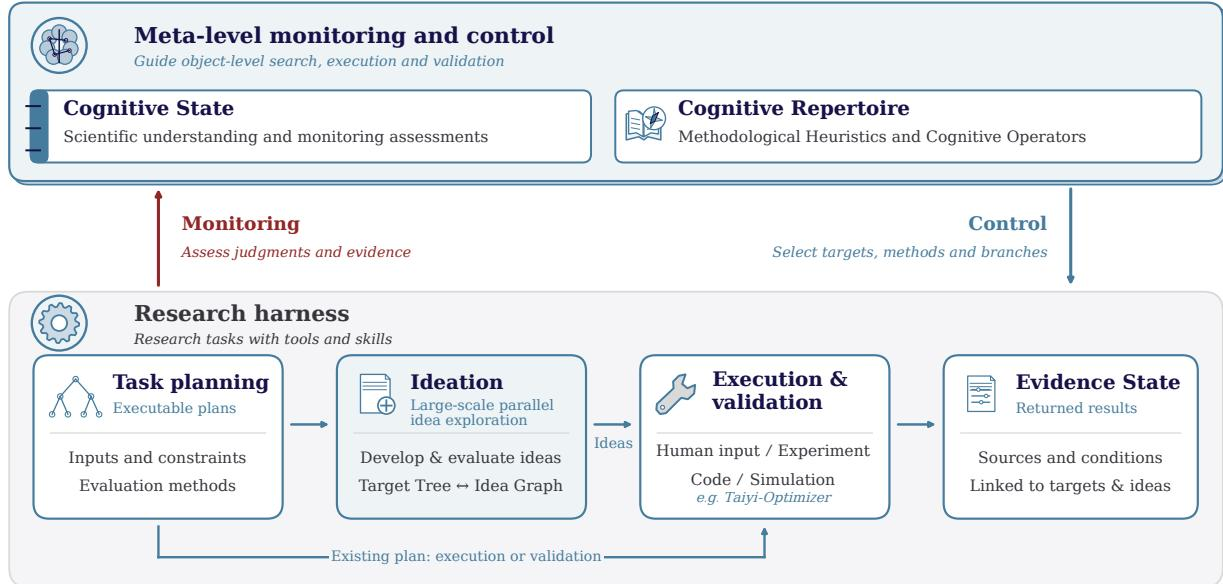
The authors present Sage-Taiyi, a metacognition-inspired architecture for scientific discovery where the search for ideas and the understanding of the scientific problem develop together. The system is organized into two interacting levels: the object level, which conducts scientific search, and the meta level, which regulates this search through monitoring and control.
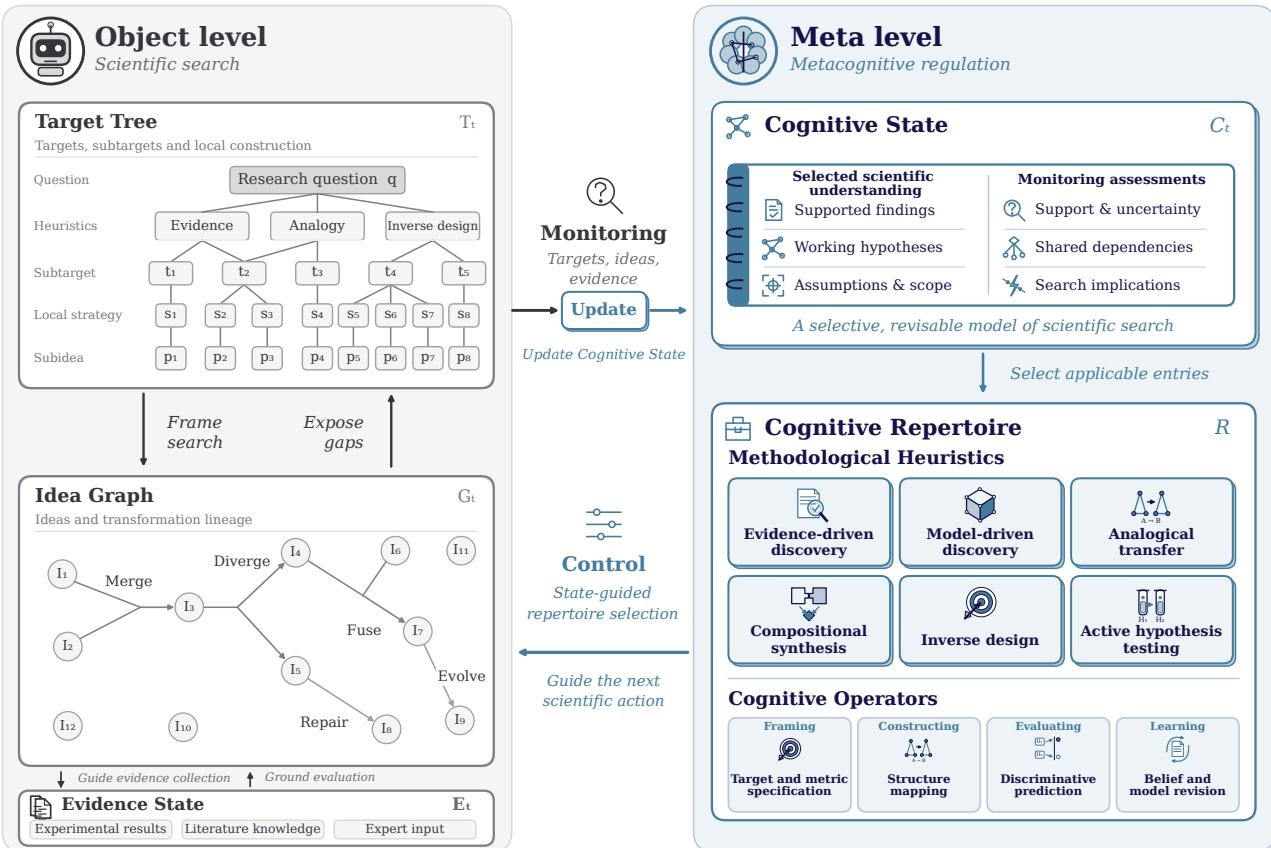
At the object level, the system constructs and transforms ideas across target branches. The search state is defined as Xt=(Tt,Gt,Et). The Target Tree decomposes the research question into specific targets and subtargets, each paired with local strategies. The Idea Graph records ideas as nodes and their transformations as edges. Ideas enter the graph by assembling subideas or through direct generation. Five transformations, informed by population-based search and conceptual combination, produce new ideas: Merge consolidates similar approaches, Fuse combines complementary mechanisms, Diverge opens different branches, Repair fixes dependencies, and Evolve improves ideas while retaining core mechanisms. The Evidence State grounds scientific search in external information, recording experimental results, literature knowledge, and expert input to form scientific judgments.
The meta level assesses how scientific search is proceeding and decides how it should be adjusted. It maintains the Cognitive State Ct, which records what the search has established about the problem and implies for further search, and the Cognitive Repertoire R, which retains reusable methodological heuristics and Cognitive Operators.
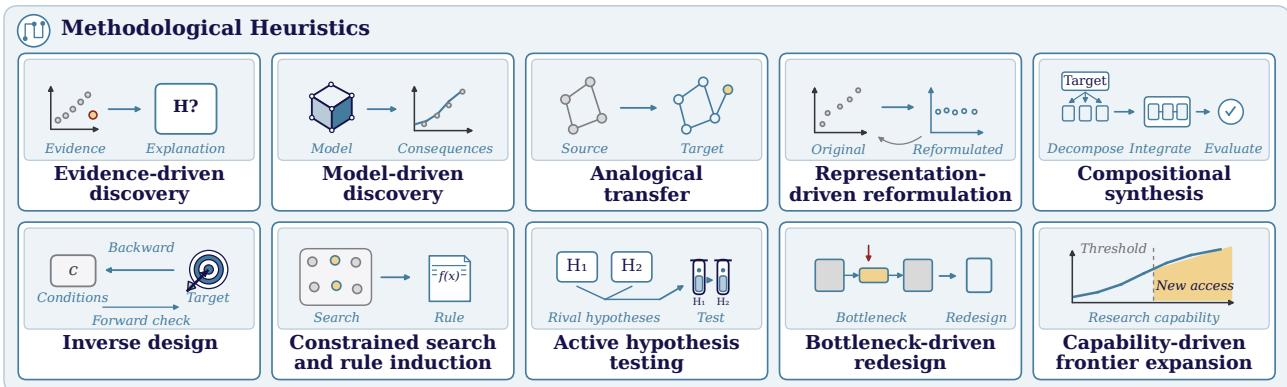
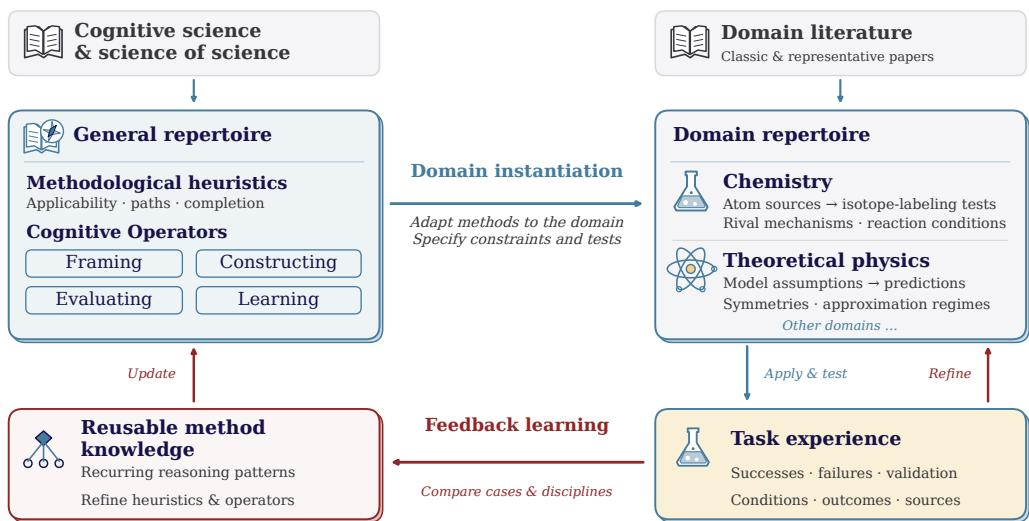
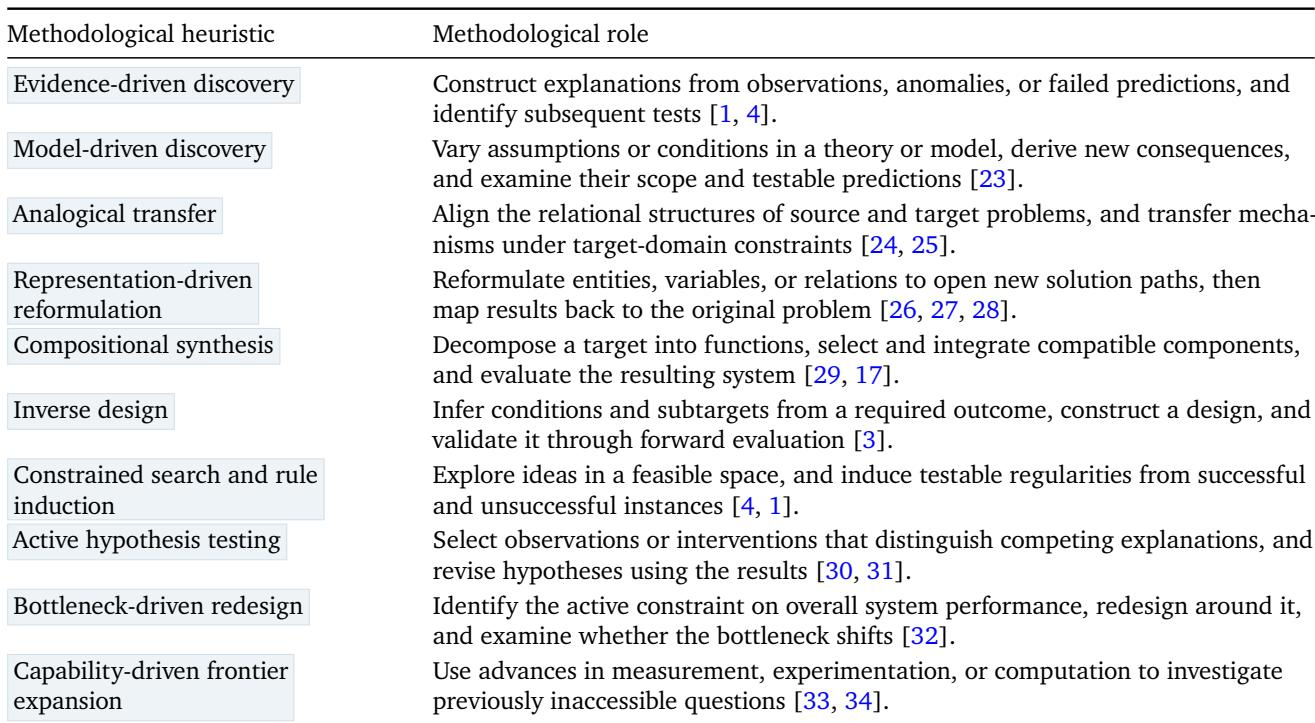
Methodological heuristics organize complete research workflows. Since the space of possible research paths is large, the authors leverage ten methodological heuristics to guide research paths efficiently. Each heuristic specifies applicability, decomposition strategies, and evaluation criteria.
Cognitive Operators are local reasoning transformations reusable across methodological workflows. They are organized by function: Framing specifies targets and requirements, Constructing develops and transforms ideas, Evaluating examines evidential support and testable consequences, and Learning uses search outcomes to revise the Cognitive State.
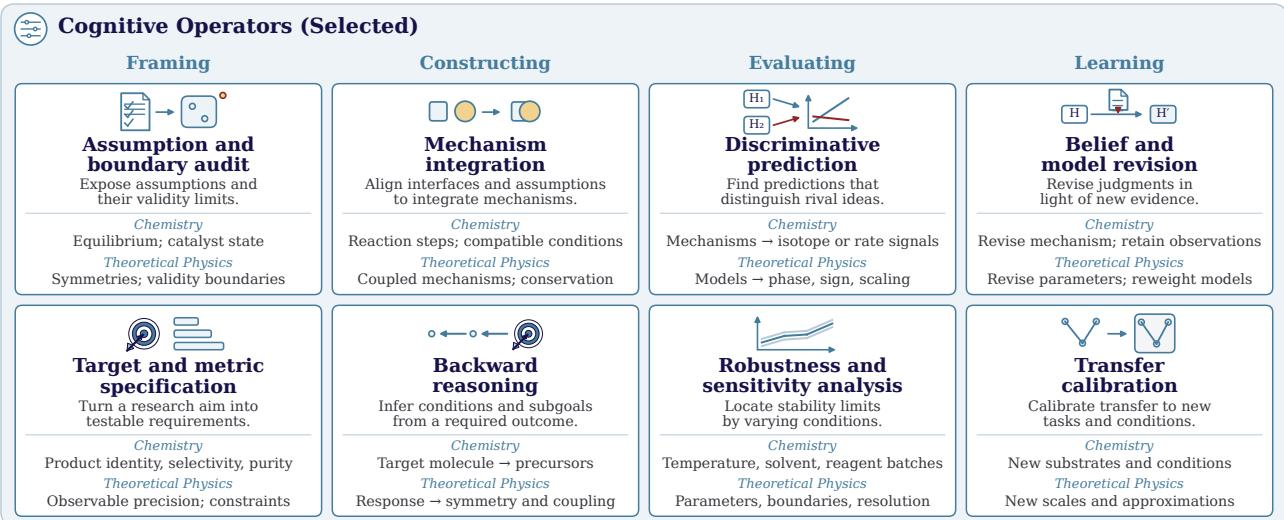
The Cognitive Repertoire combines general heuristics with domain-specific research methods. Domain instantiation maps general reasoning procedures to domain objects, mechanisms, and constraints. Feedback learning uses task outcomes to refine these entries, allowing revised methods to be instantiated in further domains and closing the learning loop.
Monitoring and control connect the two levels. Monitoring interprets search outcomes and new evidence to update the Cognitive State:
Ct+1=Monitor(q,Xt,Ct;R)Control uses the updated state to select applicable methods Rt and guide subsequent scientific actions:
Rt=Select(q,Xt,Ct+1;R),Xt+1=Search(q,Xt,Ct+1;Rt)The research harness translates control decisions into research tasks. It refines selected tasks into executable plans and selects appropriate tools. During ideation, the Target Tree and Idea Graph guide subagents to explore multiple reasoning paths in parallel. Results enter the Evidence State, and monitoring uses this evidence to verify conclusions and update the Cognitive State. This loop connects candidate solutions to experiments and simulations, with domain experts participating in validation.
Experiment
The experiments evaluate Sage-Taiyi through benchmark comparisons and real-world research applications. Taiyi-Bench tests scientific ideation across ten domains by reconstructing research decisions and assessing both rediscovery of established routes and open-ended idea quality, where Sage-Taiyi outperforms baseline systems in decision recovery, novelty, diversity, effectiveness, feasibility, and efficiency. Additional evaluations on AgentIdeaBench and IG-Arena confirm that it builds on prior research and generates original, feasible directions. Five case studies in metal catalysis, photoredox catalysis, metamaterials, alloy design, and compressor engineering further validate its ability to translate ideas into measurable experimental and engineering outcomes.
Sage-Taiyi organizes methodological heuristics into reusable research workflows, each with a distinct role such as constructing explanations from evidence, varying model assumptions, transferring structure by analogy, reformulating representations, composing systems, designing inversely from required outcomes, or inducing regularities through constrained search. Each heuristic specifies when it applies, how it decomposes research targets into subtargets and local strategies, and how it coordinates cognitive operators and evaluates resulting ideas. Control selects among these heuristics according to the research question and current cognitive state, and the selected heuristics guide construction of the target tree. Evidence-driven and model-driven heuristics move from observations or model variations to explanations, new consequences, and testable predictions. Analogical transfer and representation-driven reformulation create new solution paths by aligning relational structures or changing how entities and variables are represented. Compositional synthesis and inverse design decompose targets or infer conditions from required outcomes, then evaluate the resulting systems through forward evaluation. Constrained search and rule induction explore a feasible idea space and derive testable regularities from successful and unsuccessful instances. In the compressor case, heuristic-guided workflows generated multiple design routes and expert selection plus CFD feedback refined geometric parameters across optimization rounds.
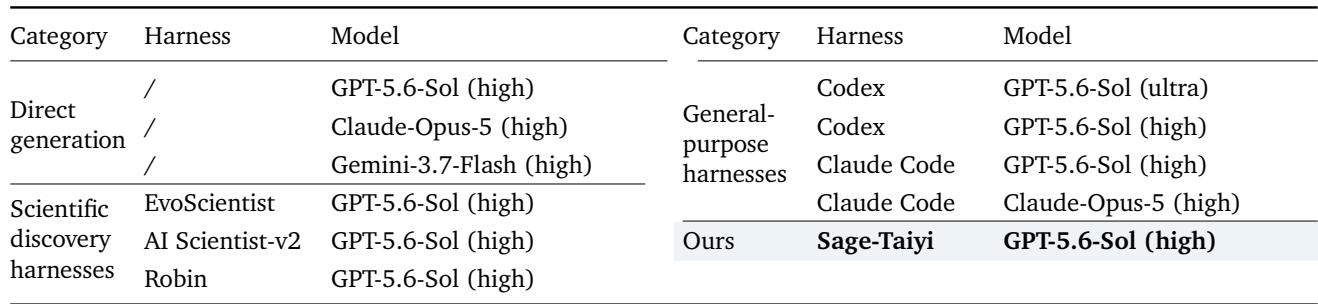
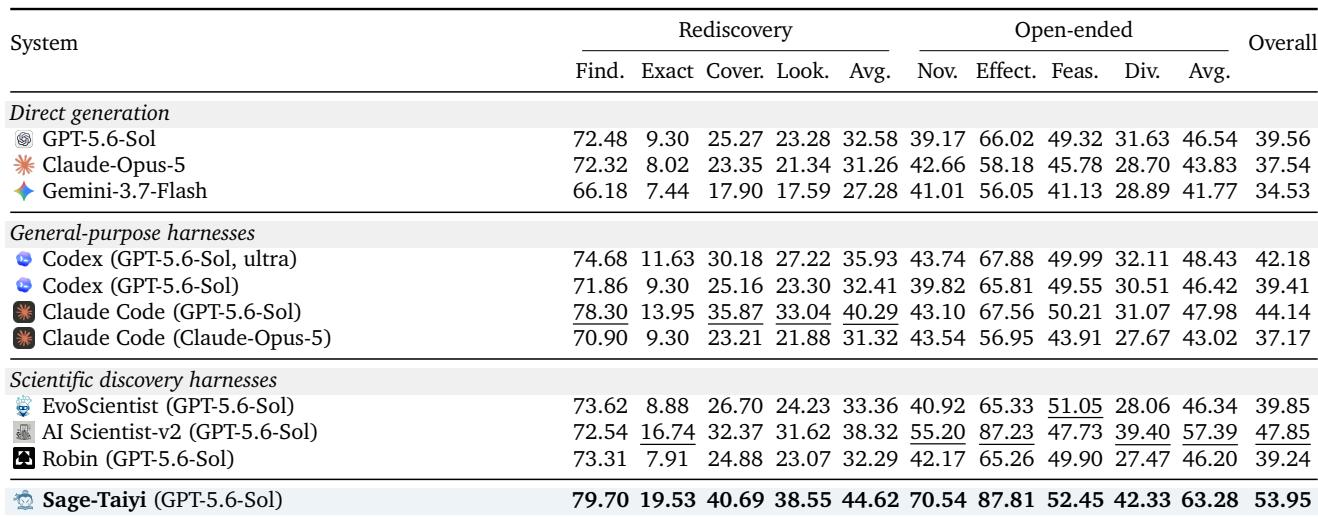
The evaluation compares Sage-Taiyi with baseline configurations spanning direct generation, general-purpose harnesses, and scientific discovery harnesses. Most configurations use GPT-5.6-Sol at high reasoning effort, including Sage-Taiyi and the scientific discovery harnesses, while a few direct-generation and harness baselines use Claude-Opus-5, Gemini-3.7-Flash, or GPT-5.6-Sol at ultra effort. This setup supports controlled comparisons by keeping the base model and reasoning level aligned across many baselines. Direct generation baselines run GPT-5.6-Sol, Claude-Opus-5, and Gemini-3.7-Flash at high reasoning effort without a harness. General-purpose harness configurations include Codex and Claude Code paired with GPT-5.6-Sol or Claude-Opus-5, with one Codex condition using ultra reasoning effort. EvoScientist, AI Scientist-v2, and Robin all use GPT-5.6-Sol at high reasoning effort, matching the Sage-Taiyi configuration. Sage-Taiyi uses GPT-5.6-Sol at high reasoning effort to facilitate comparison with baselines sharing the same base model and setting.
Sage-Taiyi achieves the highest overall score of 54.0 and ranks first across all eight metrics, with rediscovery and open-ended scores of 44.6 and 63.3. It exceeds the strongest baseline by 6.1 points overall, while the reported general-purpose harness improves over the direct generation systems shown. Sage-Taiyi surpasses the strongest baseline in overall, rediscovery, and open-ended performance. Sage-Taiyi records higher coverage, lookahead, and exact scores than the strongest baseline, indicating stronger recovery of established scientific decisions.
Under the same GPT-5.6-Sol setting, Sage-Taiyi leads all compared local systems on AgentIdeaBench, achieving the highest weighted mean and the highest score on every rated dimension. Its largest relative gains are in originality and feasibility, where it extends the lead over the strongest local baseline. The other systems cluster below, with AI Scientist-v2 ranking second overall and Claude Code trailing across the rated dimensions. Sage-Taiyi records the top score in every evaluated dimension: originality, impact, feasibility, clarity, and specificity. Relative to the strongest local baseline, Sage-Taiyi's clearest advantages are in originality and feasibility, with smaller gaps in impact, clarity, and specificity. AI Scientist-v2 ranks second overall on the weighted mean, while Codex and Claude Code score lower across most dimensions.

Across five real-world scientific collaborations, Sage-Taiyi helped convert research ideas into measurable improvements in reaction routes, materials, and engineering designs. Expert selection and optimization were combined with experimental or simulation feedback, allowing the workflow to raise chemical yields, relax restrictive design constraints, and improve material and aerodynamic performance. Chemical collaborations improved model reactions from trace or low-yield starting points to substantially higher yields. Design and optimization campaigns produced a high-strength magnesium alloy, an electromagnetic filter with strong passband transmission, and a refined centrifugal compressor impeller.
The evaluation compares Sage-Taiyi with direct generation, general-purpose harness, and scientific discovery harness baselines, mostly under the same high-reasoning GPT-5.6-Sol setting. Sage-Taiyi integrates multiple heuristic workflows such as explanation, analogy, reformulation, composition, inverse design, and constrained search, and it ranks first across overall scientific reasoning benchmarks, with its largest qualitative advantages in originality and feasibility. Real-world collaborations further validate that combining expert selection with simulation or experimental feedback improves reaction yields, relaxes design constraints, and enhances materials and aerodynamic performance.